Book
Deepfake
Makis Malafekas
4/5
Enjoyable noir caper
Malafekas gets the honour of being the first writer with a second book review on this blog, simply because I’m excited that a first translation of his work is now available in English in a beautiful new series by Foundry Editions. In the third instalment of Malafekas’ trilogy, we follow his washed-up alter ego Michalis Krokos as he haplessly and artfully gets involved with another bunch of nasties, this time the alt-right uber rich, thugs in all but name, in a valiant attempt to help a friend, earn some money and perhaps get a good story for his next book. These thugs don’t even have the style of those from the art world from the first book of the trilogy. This is no literary fiction but it is a very funny, skilfully woven page-turner. I imagine it would work very well as a graphic novel and look forward to Malafekas possibly teaming up with an illustrator in the future.
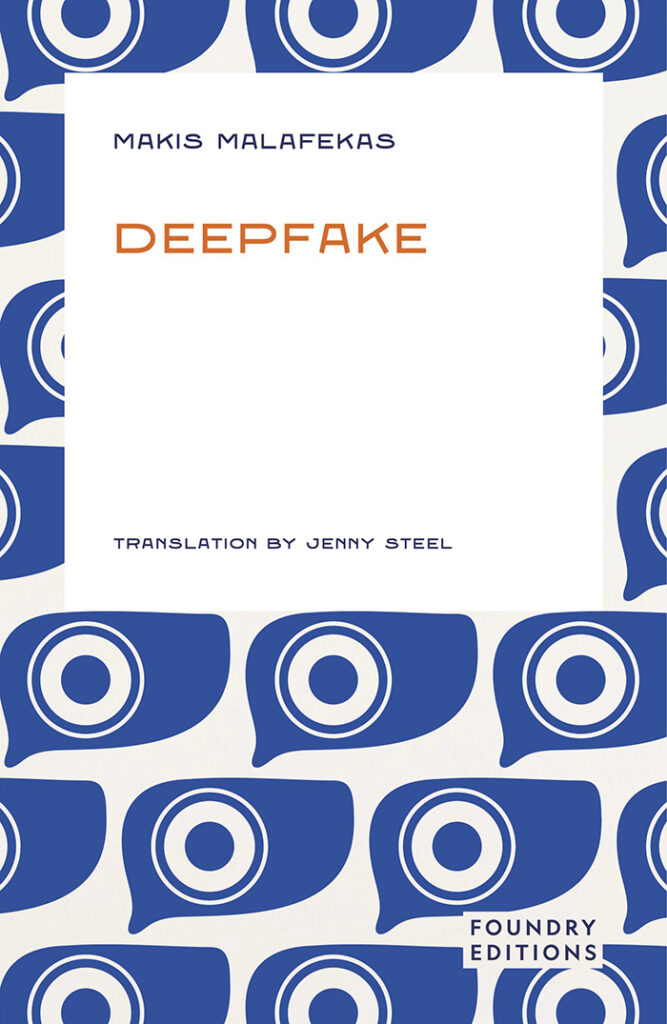
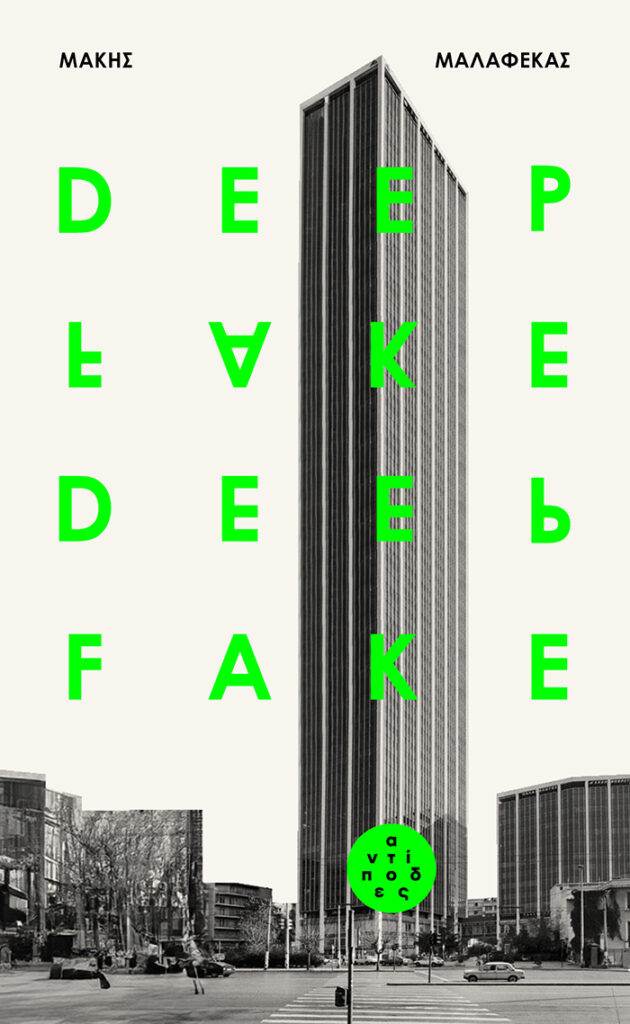
A bit more on the Foundry Editions. This new publisher focuses on translations of Mediterranean novels into English. The books are elegantly designed, lovely to hold and read, each with a unique blue pattern, this one appropriately with motif of the Greek evil eye. Although there are some wobbly moments in this Jenny Steel’s first translation, the spirit of Malafekas’ colloquial language and the momentum of his writing is conveyed with gusto.
We are in sweltering Athens again and Krokos has been sucked into the continuous livestream of the Johnny Depp/Amber Heard trial. In some ways it is as if his youth is on trial and although the outcome makes no difference to him or anyone in Greece, he is compelled to see it through, just as he is compelled to see through the ridiculous machinations he gets entangled with. All of his acquaintances seem to be rooting for Johnny and this is not at all a sign of their misogyny, but a desire for at least one hero from the past to remain untainted.
When a cool and aloof prosecutor Sofia Charitsi appears on his doorstep asking him to help his old trans friend Rebecca, Krokos is taken aback and suspicious, but also grateful to have something to do. His reaction is that of a classic noir private eye at the start of a new case:
“I couldn’t be bothered. I couldn’t be bothered to be alive, to talk, to have this woman around right now, and I couldn’t even be bothered to get rid of her. I had to find out what was going on with Rebecca, though. Besides the Depp trial was on lunch break.”
Charitsi gets to voice author’s brutal self-referential and self-mocking assessment that cuts Krokos down to size:
“’Based on the two books of yours I have read – the last two – you’re not exactly a writer. You are basically a repressed detective. Who says less than he knows, and goes all out, building up the intrigue before throwing it away on a sudden ending.’
It bothered me. For all of half a second, perhaps slightly more. Then I fixed my mouth to smile at her.”
When later his slightly creepy old school friend calls him ‘pseudo-situationist’ this also hits a nerve, Krokos and the author’s social critique exposed as lip-service to give themselves importance, tongue-in-cheek or not.
Charitsi’s scheme entails Krokos getting a job as a part-time copywriter for a well-funded alt-right outfit NHIT. Hardly copywriting, the job involves creating mendacious incendiary fragments to be used by AI to tactically flood various social and dark web networks. His credentials as a writer and his generational similarities with the boss Tsechlentidis get him hired, perhaps too smoothly, confirming the stereotypical neediness of the alt-right which unpredictably alternates with criminal ruthlessness. Tsechlentidis and Krokos can agree on one thing, that in this ancient city now marauding with tourists the authenticity has been taken away from them.
Tsechlentidis’s goons take Krokos on a sickening late night hazing expedition in their car, pursuing a seemingly random immigrant delivery driver on a motorbike until he crashes. At first it appears that the man is killed, but later it transpires that it might have been an enacted scene to freak Krokos out. Even the monsters play at being monsters, an infantile instinct they must satisfy to seem credible to themselves. We never find out for sure what had happened to the delivery driver, a deepfake symbol of everything else that is going on.
If there is one thing I don’t like about Malafekas’ writing, it’s his eagerness to portray the seedy and sleazy misogynous underworld, but one can’t deny that this is a crucial part of the scene he has chosen to talk about. Charitsi’s problem gets resolved with Krokos mansplaining to her that she has been naïve, which for a prosecutor seems an unlikely and fatal character flaw. Perhaps this is after all just the usual macho retaliation for being confident while female.
However, there is an even more ruthless player than Tsechlentidis, the super-rich and fantastically named Patriarcheas. It is so easy to turn him against his associate Tsechlentidis, since he is already paranoid and chillingly cruel. Krokos does the honours. Patriarcheas eliminates Tsechlentidis, which makes no difference. We get the characteristic abrupt ending, but we don’t care, because it is summer, the good guys are still alive and the episodic nature of the noir story comes to a logical and satisfying end.
Translated into English by Jenny Steel