Art
Portraits!
Gemäldegalerie, Berlin
4/5
Consequences of likeness
The curatorial approach of this overview of the portrait genre was to pair paintings by different artists and often from different periods and styles, and thus encourage less obvious parallels. The pairings were often frustratingly irrelevant, sometimes too literal, but occasionally inspired, sometimes unintentionally. Regardless, it was easy to enjoy this exhibition with so many gems drawn from Gemäldegalerie’s own collection.
The oldest piece of art on view was an Ancient Egyptian mummy portrait of a woman from 130-150 BC, from the Egyptian museum and Papyrus Collection in Berlin. Interesting as it was to see this surprisingly realistic portrait of a beautiful woman from so long ago who furthermore had a bit of moustache, it was paired with a safe classical portrait by Friedrich Bury. The notice suggested the eyes of both subjects were similarly stylised, but I don’t think it is possible to bring into connection an ancient mortuary portrait of a young woman with a 19th century saccharine idealisation of some minor aristocrat. It strikes me that we are comparing honesty with artificiality, and I doubt this was intended, except perhaps as a striking contrast.
There were times when the pairings worked better. Rubens’ slightly idealised portrait of a woman (likely to represent his first wife) was placed next to Gainsborough’s also slightly idealised portrait of his wife. You could recognise a conflicting desire to be truthful and to embellish. Both sitters have an interesting presence, not just as simple models, but as human beings with unique inner life. Both women have a proud bearing, but an ambiguous, slightly melancholic expression. As if self-conscious to be looked at and understood.
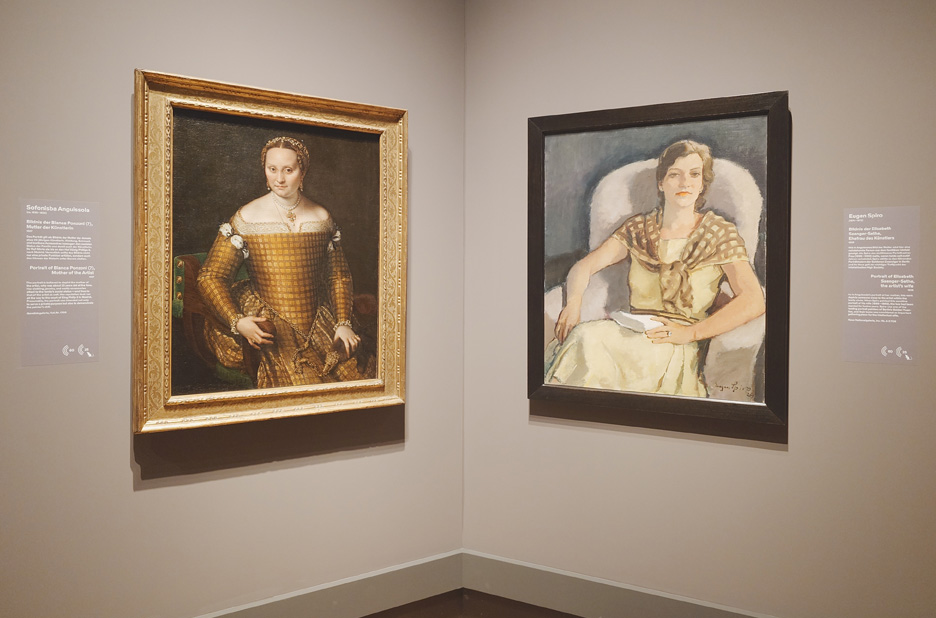
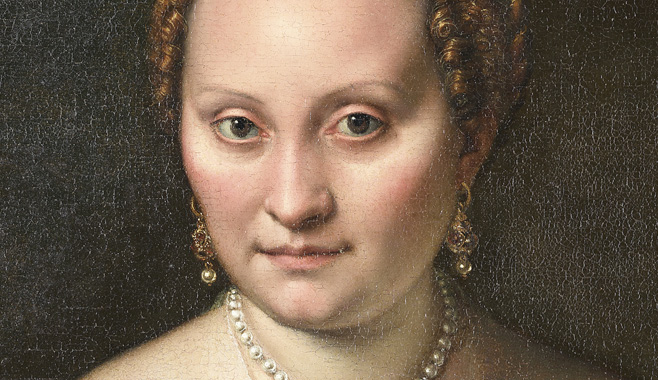
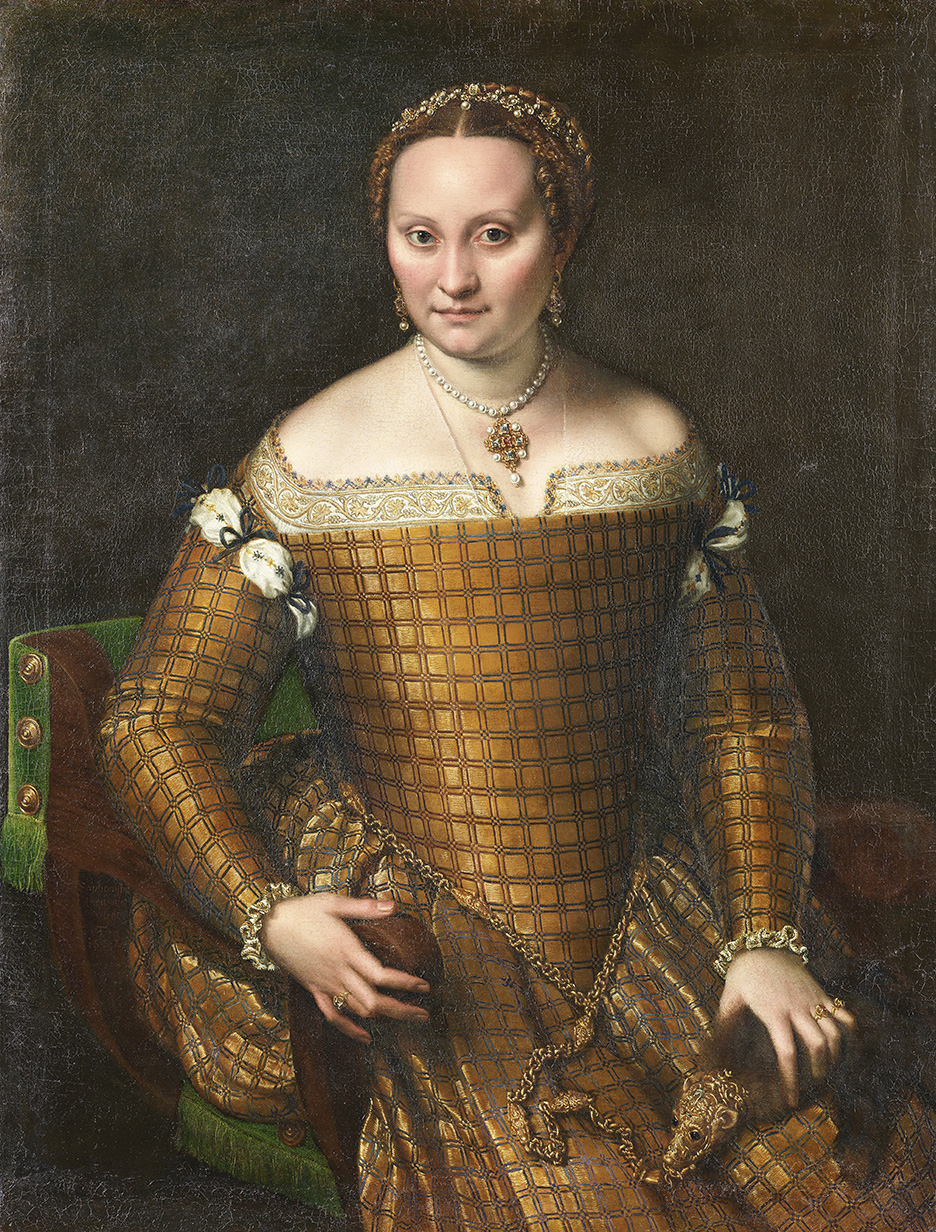
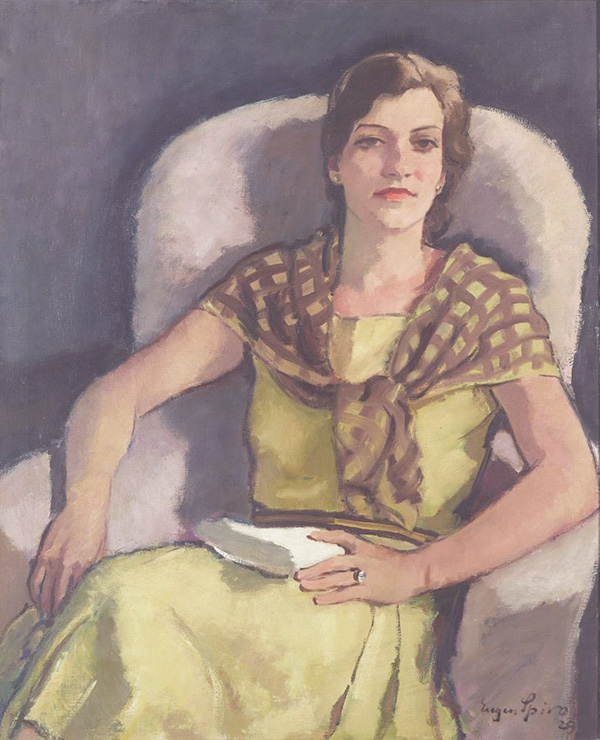
Another good comparison came from juxtaposing Sofonisba Anguissola’s portrait of her mother and Eugen Spiro’s portrait of his wife. Both paintings inhabit the yellow spectrum, Bianca Ponzoni in a rich golden dress, Elisabeth Saenger-Sethe in a sunny pale yellow one. But the most pertinent connection is the strength and confidence of the two women from different eras, Bianca almost forceful in her armour-like outfit, Elisabeth supremely calm. I have admired Anguissola’s painting before as a rare example of a representation of a mother and a woman that is both strong and beautiful, like a painting of a ruler. Spiro’s very different, but also excellent work, brings Anguissola’s defiant representation closer to our time.
I was hoping Anna Dorothea Therbusch’s self-portrait from the Gemäldegalerie’s collection would be included and indeed it was. The magnifying glass magnifying us, her subject, for the painter’s consideration. The fact that only the head and the dress are painted in detail also appears like a playful allusion to the lens, helping the painter concentrate only on that which she chooses, only on that which matters. The rest can be magnificently blurred and unfinished, and the painting as a whole still succeeds. It is one of the most masterful canvases on show.
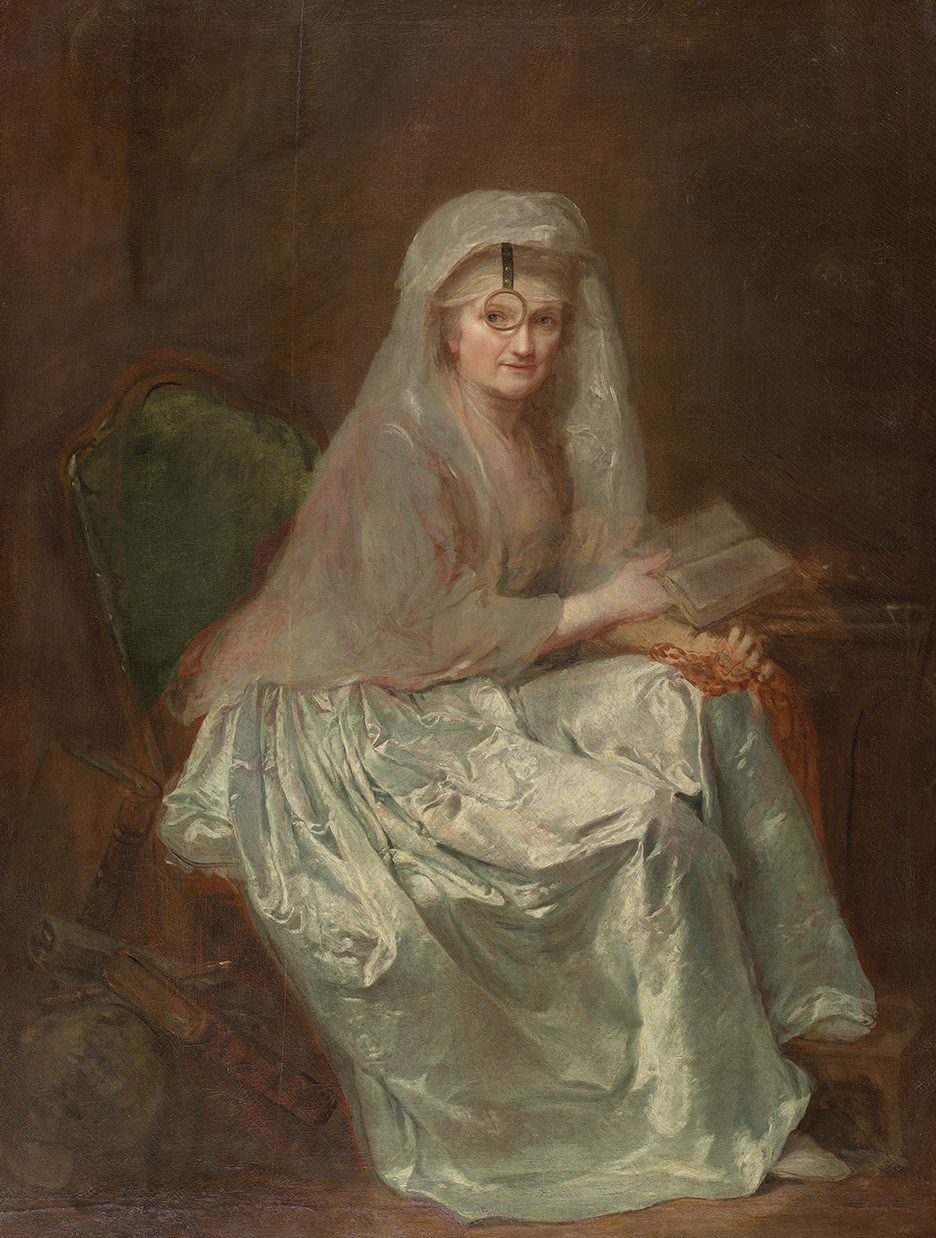
At this point I noticed Therbusch’s companion piece and thought that the curators had a sense of humour after all. Next to the Therbusch was a vain rococo piece by Nicolas de Largillierre portraying the sculptor René Frémin. Frémin poses with his white wig, unbuttoned shirt and pretentious expression, while coquettishly gesturing towards the viewer as if inviting him to admire his superiority. I just could not believe that these two paintings have been put together. There was no comment on the pairing in the notices on the wall. There could hardly be a bigger contrast between two portraits from the same period. The male artist full of himself, the female focusing on her subject matter. The male artist posturing, the female taking herself seriously. In a pleasant reversal of roles, it is the male artist who is flirting with the viewer, while the female artist is asserting her intellectual status.
Portraits of power were less interesting. Then there were of course a Dürer and a Cranach, both excellent. Out of several great portraits of very young beautiful unsuspecting brides to be, Rogier van der Weyden’s was structurally the strongest, starting from the crisp white headdress at the top, moving onto vertical pleats on the bust and ending at the bottom with minutely detailed bejewelled hands, just in view, one over the other. That the sitter was pretty had stopped mattering a long time ago.
I don’t ever remember seeing a painting by Anthonis Mor that wasn’t impressive. In his double portrait of the Utrecht canons the symmetry is cleverly subverted. One man looks at us, the other to the right, but the praying hands of the first man, off centre, remain the focus. The precise off-kilter composition turns this obviously religious canvas into a work about painterly mastery.
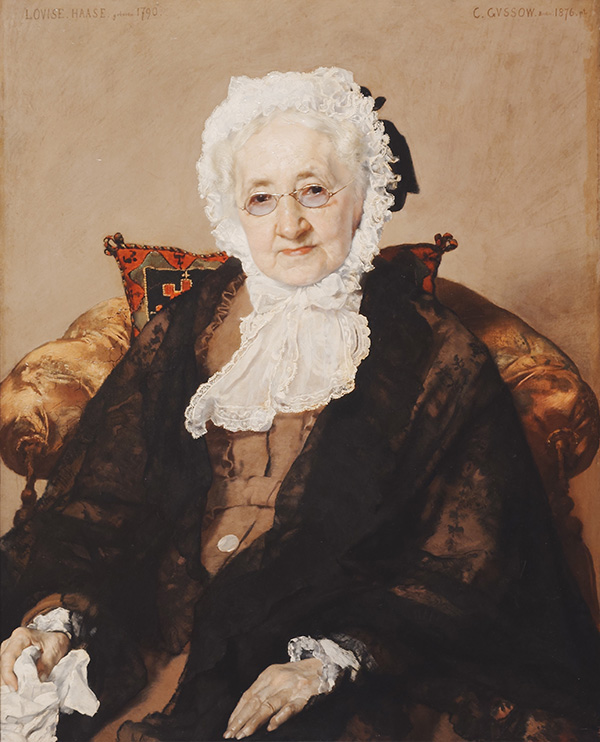
I wanted to end with a German painting by a lesser-known artist, moreover from the unloved and sentimental 19th century. Carl Gussow’s portrait of Louise Haase is a captivating vision of old age. Traditional, but well executed and memorable. Louise looks at us through her gold rimmed round glasses which stand out as if in relief. Her kindly face seems more serious on closer inspection. Everything she wears is conventional and immaculate, but the worn upholstery of the chair mirrors her age with gentle humour.