Book
Sea now
Eva Meijer
4/5
The colossal flood that is in our future
Slowly the contours of the flood become more existential, sombre, biblical. The inevitability of nature reasserting itself becomes completely clear. It is when the horses start breaking free, after the foxes, rabbits and various birds have long left, that the fear firmly takes root.
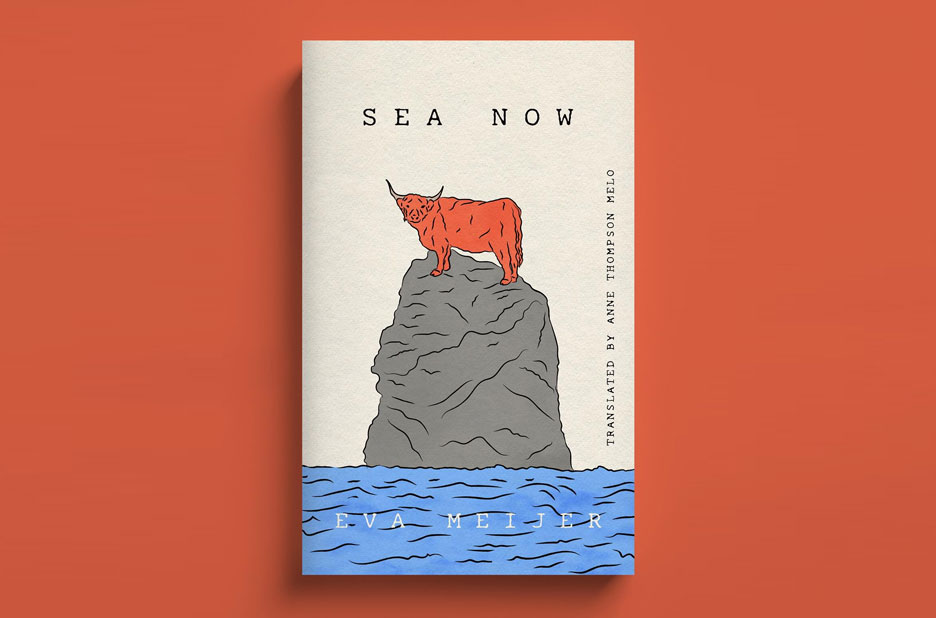
Eva Meijer’s vision of our near future – beautifully translated by Anne Thompson Melo – where the whole of Netherlands is gradually submerged by a flood of mythical proportions, rises to the challenge to describe blow by blow, or wave by wave, how it may all come to pass. The writing is colloquial and fluid, carrying with satisfying momentum and witty humour human reactions and behaviours, doomed or inspiring, leading humans and animals to eventually take the only path available – to flee.
The flood starts innocuously with a high tide that will not retreat and nobody is sure what this means. As the political conversations start to heat up and become convoluted, there is a beautiful scene of dune rabbits all leaving the coastal area together, and this magical moment distracts everyone from whatever remains of their survival instinct, also causing a pile up on the motorway, revealing humans who observe and dither rather than act.
Meijer’s thoughtful evocation of the gradually increasing fear and discomfort gives a soft warning of what is to come. There is no perfect response, it all comes to damage limitation. The older members of the population are the first to stir, recalling earlier floods and loss of life, carrying in their genetic memory a healthy fear of the sea. After a while everyone becomes uneasy and aware of the fragility of their life on reclaimed land.
Everyone suspects that the reason for the flood is climate change, but nobody knows exactly what is going on, although scientists are busy taking and analysing samples, building forecast models and not being able to draw any conclusions. It’s not that knowing the exact scientific reason would make any difference to the reality of those affected. Later we find out that the weakening of the Gulf Stream is the cause, although again, this does not provide any practical wisdom.
Meijer attempts to discern sea’s personality and motives, which in literary terms can be hit or miss. When her speculation is matter of fact, philosophical and satirical it tends to work better than when she gives way to lyrical descriptions and poetic fragments which can at times be trite and empty. The power of her writing does not seem to reside in the poetic, but in the observational astuteness of how a country like Netherlands with its present political and social structures would deal with a destructive event of such proportions. With the likelihood of such a disaster increasing, you would expect the political establishment to be prepared, but as we have leant with Covid, this is definitely not the case.
Called ‘remainers’, in humorous contrast to those of the anti-Brexit persuasion, the part of the population who have decided to be in denial of the events desperately latch onto known conspiracy tropes to claim the government has invented the disaster. When they end up living on the roofs of the obviously flooded areas they simply adapt their beliefs to say that the government wants to wipe them out. So far so human.
The vanity of the politicians, their prevarication and acting based on probabilities rather than convictions are all incisively described. The King goes to his holiday home in Mozambique and stops answering his phone. Plausible. The Prime Minister delays the evacuation until last minute, thinking that the most important thing is to maintain good morale among the population. His capable defence minister, incidentally a woman, is the one who rolls up her sleeves organising the army to help the evacuation, rescue and the attempted reinforcement and building of new flood defences. All to no avail as the sea just advances. Media keeps reporting and playing off all the sides. No news there.
In the second half, the story concentrates on three women, the scientist Steen, the climate activist Arie, and the young girl who likes to be called Willow. They take a research boat to attempt to find and comprehend what they have lost. The narrative becomes increasingly weaker and somewhat pointless. Like its three remaining characters, it no longer has a purpose. It is regretful that the writing runs out of steam as there are many interesting observations made up to that point that could have been wrapped up in a much more satisfying conclusion.
What do we learn? That all the talk and activism is just too late. That people will behave in the same way they always do, some will find their strength and humanity in these challenging times, others will be destructive out of fear and inability to adapt. That the politicians will play safe, but when pushed will try to do their best, although some of it will be way too late. That many will die, some quite needlessly and others in quite surreal circumstances. That the domestic animals will bear the brunt of it as it will be impossible to save them all. That life will continue as it always does. That the baton will be passed on to the younger generations to screw it all up for themselves.
Sea now is translated by Anne Thompson Melo