Art
Lovis Corinth – Then Came Berlin!
Berlinische Galerie, Berlin
5/5
Bearing his rugged soul
Lovis Corinth, a great German painter, less well known outside Germany, is a subject of a large well-curated retrospective at the Berlinische Galerie. Born Franz Heinrich Louis in Tapiau, Eastern Prussia (today’s Russia) in 1858, Corinth adopted his altered middle name, Lovis, as his first name. He achieved success and notoriety in Berlin where he settled in 1901. The painting which made his name, Salome II, was unfortunately not on display, but there were plenty of others to get to know and enjoy, the majority owned by the Berlinische Galerie.
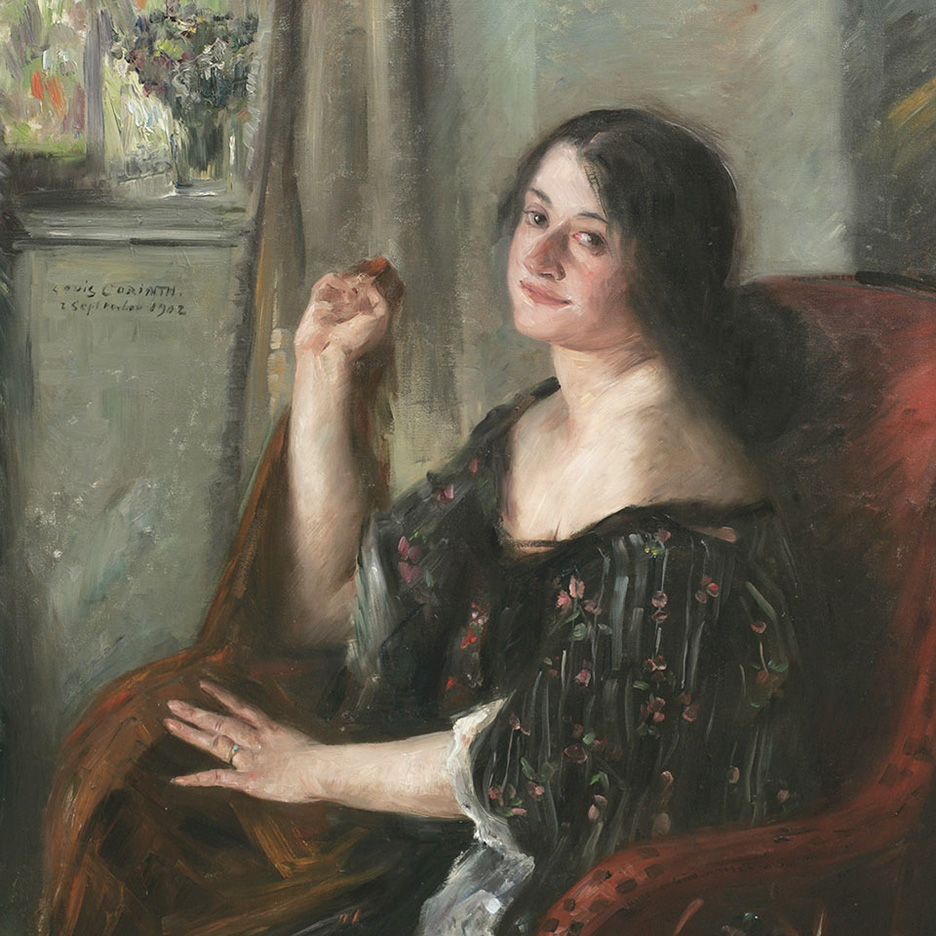
Most of Corinth’s society portraits on show are unremarkable, either safe or sentimentally dramatic. But when he is painting those close to him, family, friends or himself, the results are much more engaging and authentic. Many paintings of his wife are perspicuous, warm, and emotionally and psychologically refined. The portrait from 1902 for instance captures Charlotte’s unusual expression sitting on a homely chair, looking at her husband, as if wondering what he is up to this time, a combination of curiosity, patience and readiness to be surprised, disappointed or made to laugh.
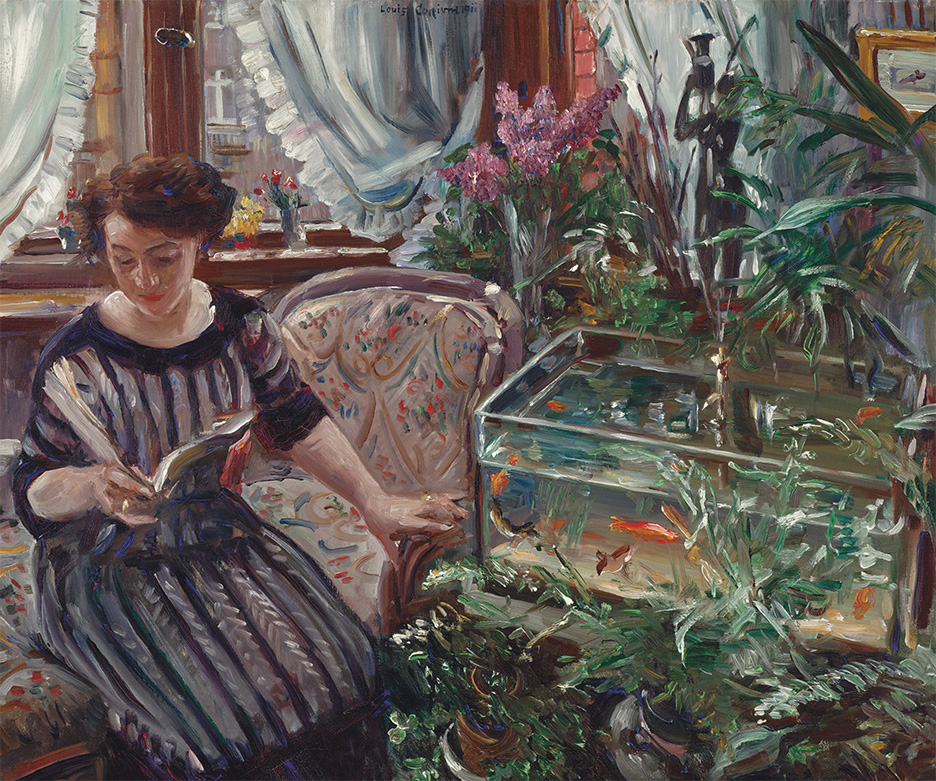
Another great painting reminiscent of Matisse, Woman by a goldfish tank, is split into two halves and intersected by many compositional diagonals. A woman reading on the left is facing unruly greenery surrounding a fish tank on the right. Her stretched arm on the boundary between the two areas keeps the chaos of nature at bay, but also engages with it, as if through the intellectual work of reading.
Initially a realist painter, Corinth adopted the impressionist style but gave it his own distinctive flavour. His brush was often much freer and more rugged than that of other French and German impressionists. He was an artist who took himself seriously, but there is also often a refreshing hint of humour in his work, an irreverent tongue-in-cheek note, most regularly seen in his annual self-portraits.
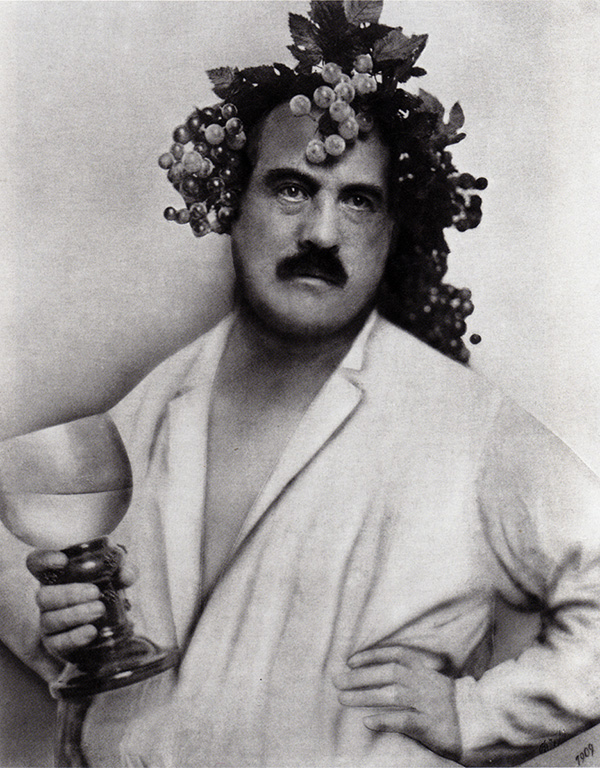
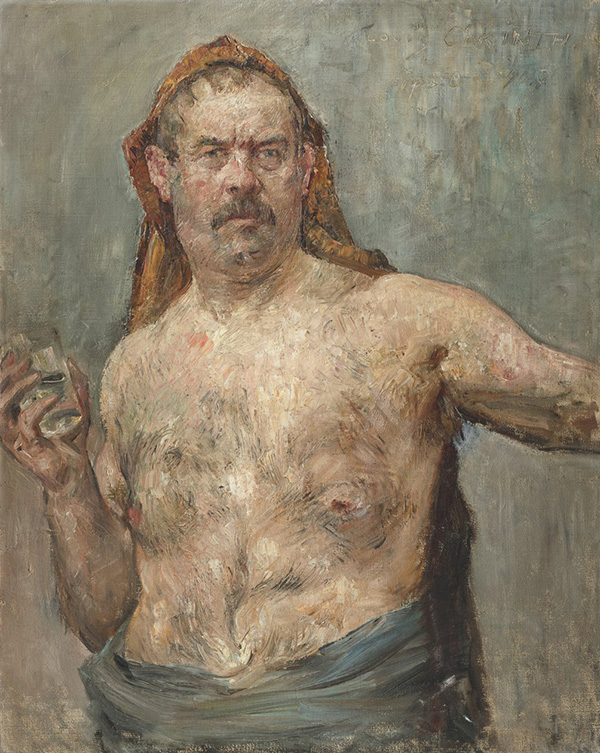
By all accounts Corinth liked to party. He also liked portraying himself with various props and sometimes even armour. We get to see several of Corinth’s self-portraits through the years, from his first from 1887-8, to a late one from 1923. Their defining characteristic is the author’s unflinching stare in the mirror that sometimes looks unhinged and almost comical in its intensity. Such open uninhibited observation of self is rare. Corinth had a rugged peasant physique, but was not self-conscious, rather he always presented himself truthfully and confidently, sometimes with a mix of narcissistic and self-deprecating irony. The self-portrait from 1907 shows the painter’s bulk unflatteringly naked, a cloth around his waist and head, and a glass in his hand. The other hand is off-canvas, presumably holding a brush. He appears disturbed and therefore brave, comically heroic, bearing his body and soul for his art.
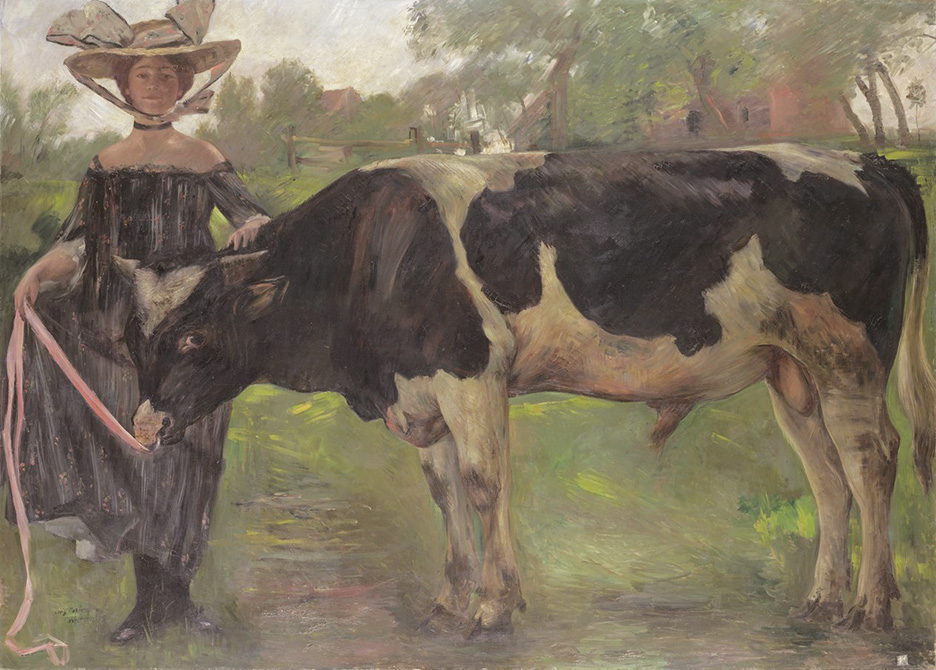
When I first saw Girl with bull, I found it hilarious, but I didn’t know then that the prize bull in the painting is supposed to stand for the painter enamoured with his student, Charlotte Berens, pictured as a young woman showing off the large animal. The bawdy symbolism caused a scandal, but the painting is still funny with the majority of its large surface taken up by the calm fat bull and by the contrast between the bull’s apparent controlled placidity and the girl’s prim and proud posture.
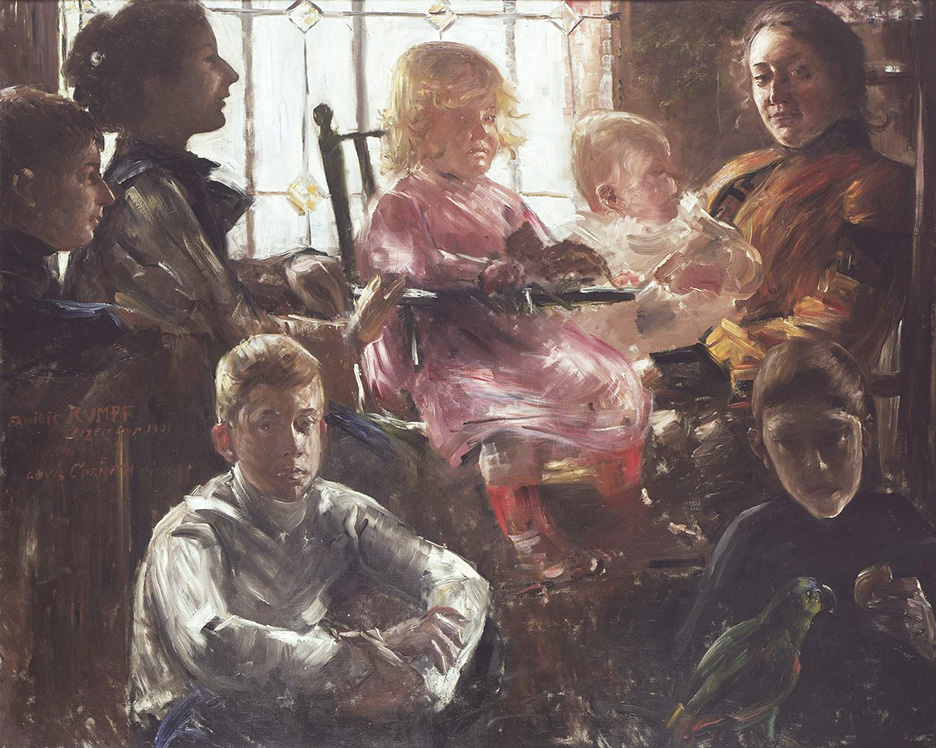
In The family of the painter Fritz Rumpf seven members of the family are crammed into a landscape canvas, the mother and six children of different ages. All are painted against the light. It is a remarkable vision of children’s faces gradually taking shape against their mother’s more clearly lit and defined features. It is an unashamed image of domesticity, of household togetherness and also boredom, which still ensures everyone’s character retains its unique possibilities.
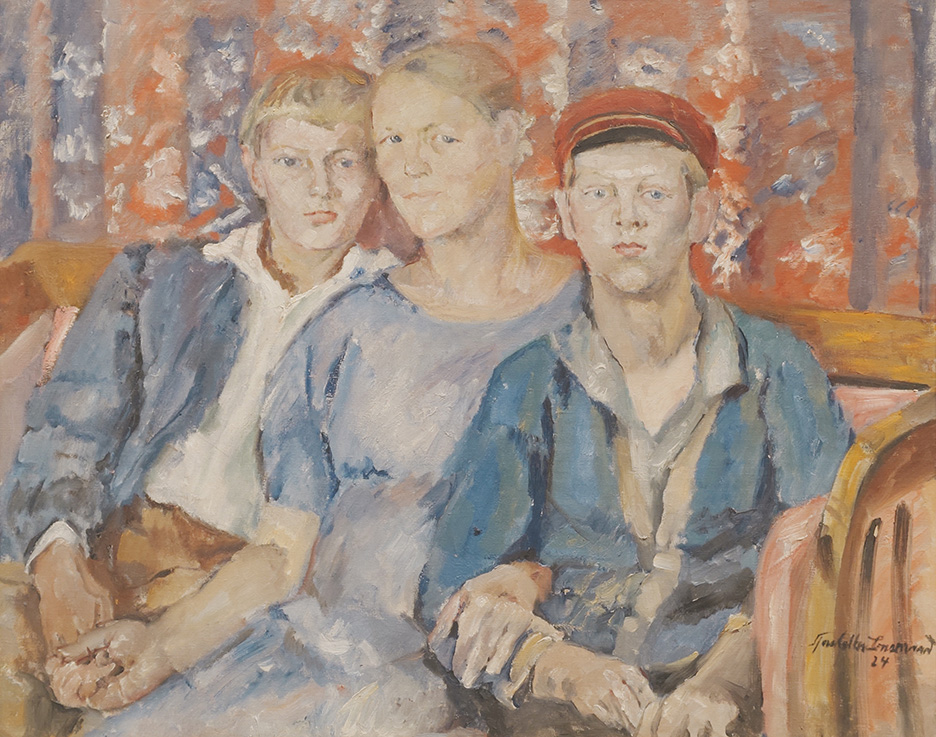
Corinth was obviously a good teacher as testified by many featured works of his pupils, many of them women. We get to see a confident early self-portrait by August Macke. But the most interesting aspect of Corinth’s teaching is that his wife, Charlotte Berend, who was his student, was also an excellent painter. Her husband was mostly progressive in his opinions to allow women to study art just like men, and mostly supported her continuing to paint, although he also expected her to deal with the traditional wifely household chores. Several of Berends’ canvasses are included confirming her skill and talent. Portrait of Lisa Winchenbach with her son Felix and Thomas Corinth shows her friend with her son and Charlotte’s son Thomas sitting on a sofa with a colourful background emulating the closeness and the blue clothing of the sitters. Charlotte outlived her husband and due to her Jewish ancestry emigrated to US in 1939.
Corinth’s epic Katzenellenborgen cycle, consisting of 11 large paintings takes pride of place in the spacious atrium of the Berlinische Gallerie. These huge mythical canvases on the subject of Homer’s Odyssey and Ariosto’s Orlando furioso are reminiscent of Max Beckman’s work with their palette, treatment of figures and narrative approach.
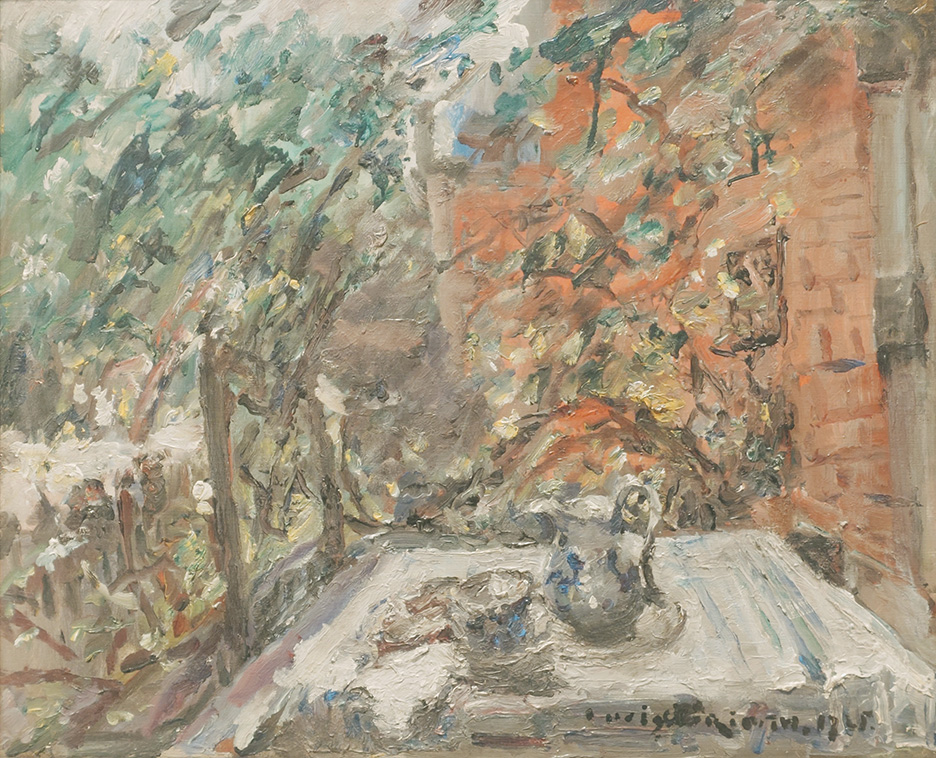
Towards the end of his career Corinth’s style became even freer in a way that appears closer to expressionism to follow. Snack on a balcony painted in 1925, in the year the painter died, a still life surrounded by a landscape, is structured with diagonals and unruly organic lines. This energetic celebration of the human ability to observe nature also leaves a place for the softness of the filtered light.