Theatre
Bengal Tiger at the Baghdad Zoo
Young Vic, London
3/5
Creative but marred by evading ethical questions
Rajiv Joseph’s play attempts to represent the aimless confusion, sorrow and trauma of the aftermath of the Iraq War, after the outrageous damage had already been done, but offers no catharsis or development other than a depiction of a no man’s land where the characters, dead and alive, roam like in purgatory without being able to achieve any meaningful resolution. The same is unfortunately true of the audience, following the surreal dialogue and the scenes which are sometimes very powerful, but don’t form part of a greater whole.
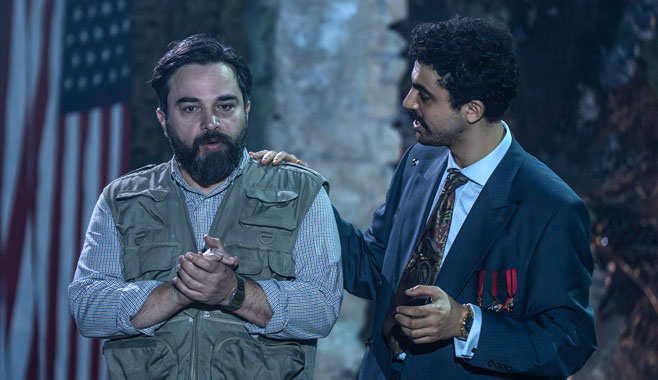
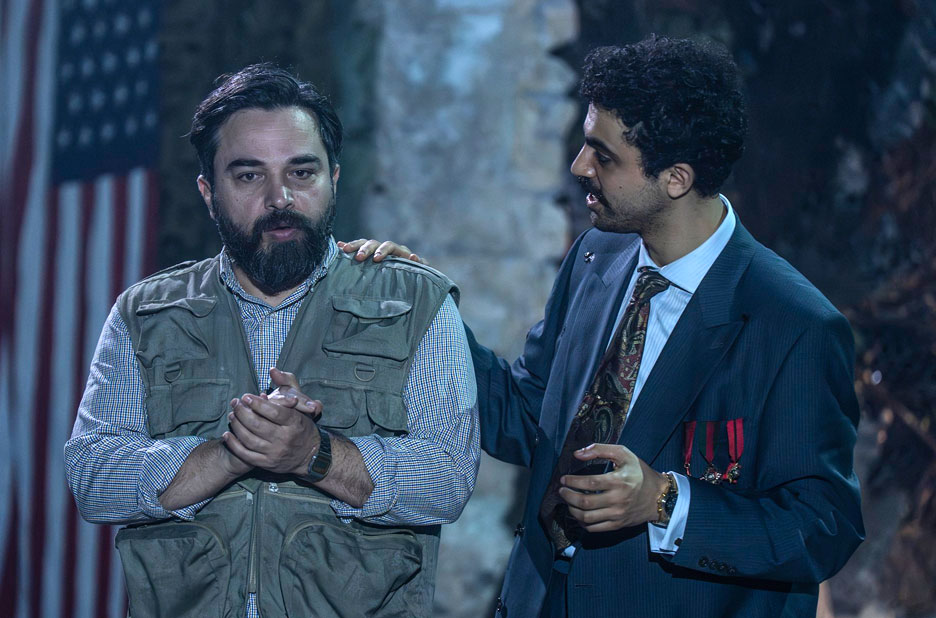
Two immature, dumb and aggressive American soldiers, Tom and Kev (Patrick Gibson and Arinzé Kene), who have not understood anything and who continue to be profoundly misguided and naïve about what surrounds them and what their actions mean, are nevertheless traumatised. They kill a Bengal tiger in the Bagdad Zoo as a result of their own stupidity. The tiger, played by an ordinarily dressed Peter Forbes, proceeds to haunt the play, offering moments of trite stand-up comedy in the Iraqi wasteland, meditating on philosophical and base matters in turn. Including this character allows Joseph to provide some distance from the difficult subject matter and as such it is a great idea although not sufficiently developed to make any important contributions. As a symbol of guilt and desire to comprehend and alter course, the tiger is well placed to offer a fresh point of view, but this is not used convincingly beyond the opportunities for light humour and some very unoriginal religious thoughts. Robin Williams played the tiger in the New York staging of this play in 2011 and I can imagine that this casting choice was a stroke of genius.
In 2011 the Iraq War was just coming to an end, so this was a much more topical subject offering perhaps some needed release. Now in 2026, although US aggression on foreign soil unsurprisingly continues, cultural urgency of this particular topic is felt much less keenly, particularly as the play is written from a US perspective with Joseph making everyone a victim thereby avoiding probing ethical questions. Staging this play shows how the UK is still unwittingly in thrall to the American vision of the world.
Ammar Haj Ahmad excels in the role of Musa, an Iraqi gardener who becomes a translator to the American forces. He is the only character the audience can empathise with and who attempts throughout the play to understand what is happening around him and to him. In one of the most successful scenes Musa asks to hold Saddam’s gold gun which Tom had originally stolen together with the gold toilet seat with a grand plan to flog them on eBay when he gets home. Musa is bewildered by this object which symbolises so much to him. Observing his agitation in trying to come to terms with what he has in his hands is intensely moving.
In another chilling scene, Uday, the dead Saddam Hussein’s son (an excellent Sayyid Aki), taunts Musa who remembers him abusing his sister. In the second half this encounter is replayed to a much weaker effect as we learn nothing new.
The very minor female characters of a prostitute, a leper and Musa’s sister, are all mostly silent and don’t attempt to show the women’s experience of war. It is another opportunity missed for widening the ethical scope of this piece.
But let’s not be beastly to the Americans. There are some interesting outlines about the surreal situations that arise from translating for American soldiers which are handled wittily and provide some more substantial cultural context. And I have to give credit to the playwright for retaining untranslated spoken Arabic in many logical places. Nevertheless, like the text itself, Omar Elerian’s direction misfires increasingly as the play progresses. Some of the scenes drag on or are somewhat confusing and pointless. The initial section where we see the American soldiers Tom and Kev arguing in parallel with the tiger voicing his thoughts is confusing in a way that is not fully intended. The tiger playing electric guitar might have worked with Robin Williams, but is rather flat with Peter Forbes. The possibility of bringing it all together in the second half definitely existed by the interval but regrettably was not achieved. Instead of building on what has been already revealed, the second half is a mere boring variation on the first, but this does not work in the Beckettian sense of establishing an existential pattern.
One thing is definitely true, even though there is no mention of American torture and killings, the US forces do not come out well at all. From a non-US point of view, this is nothing new. The only major character who has a reason for being in Iraq, Musa, undergoes a malign transformation, but similar to our daily news, his despair is given equal billing to the invader’s trauma and a tiger’s absurd existential crisis.