Music
Berlioz’s ‘The Damnation of Faust’
Proms, Royal Albert Hall, London
4/5
Exciting opportunity to discover this remarkable piece
Out of several Proms concerts I attended this year, this one was the most interesting, albeit imperfect in an exciting manner. Berlioz’s monumental piece requires a large number of musicians, soloists, orchestra and choir, which suits the large Albert Hall quite well. Acoustics being what they are, at least the sound of a very large ensemble manages to overcome the distancing and neutralising this space routinely effects. Berlioz called ‘The Damnation of Faust’ a dramatic legend which is appropriate as it is not quite an opera, or an oratorio, or a programmatic piece in the usual sense. The Christian sensibility imbues it, but not overwhelmingly so and there are some interesting considerations of the place of man in the fickle and unhospitable universe which are surprisingly relevant today. It is based on Goethe’s Faust which posits, from a Romantic and Christian viewpoint, that man is responsible for his own downfall, but there are many fascinating nuances to this which emerge in the libretto, music and orchestration of this piece.
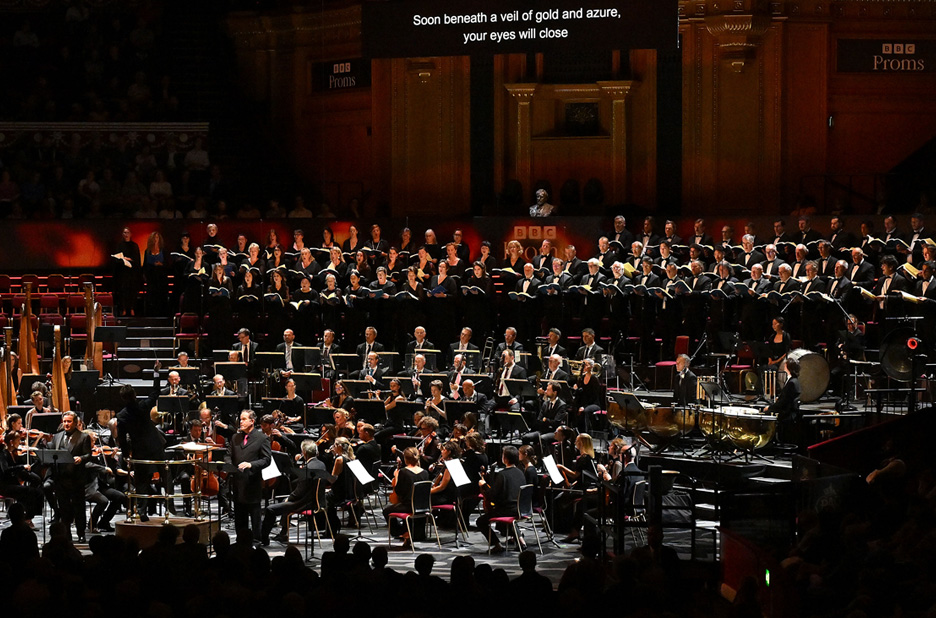
At the beginning the period-instrument orchestra Les Siècles conducted by Jakob Lehmann, John Osborn in the role of Faust and the choir introduce us to the bucolic Hungarian countryside where Faust is meditatively enchanted and generally at peace with himself, although the seeds of boredom and discontent are starting to germinate. The relaxed atmosphere extended at times to the musical precision, but the performance got tighter and the energy of the piece carried it pleasantly forward regardless.
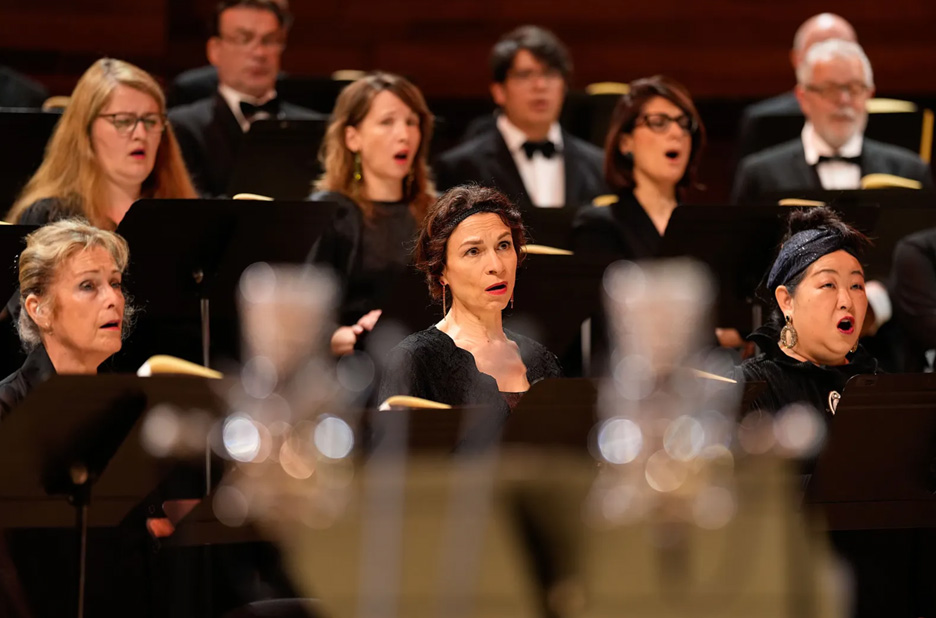
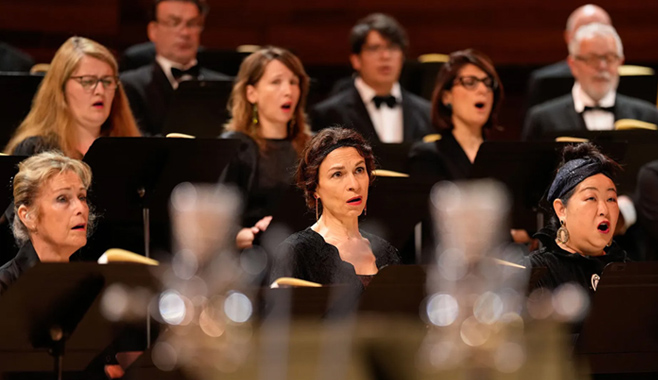
The choir, Chœur de Radio France, the only permanent professional symphonic choir in France, filled the Albert Hall with their expansive sound, immediately seizing their role as perhaps the most important participant of the evening. In the first part their melodic lines were joyfully extrovert and a touch folkloric followed by the enjoyably proud orchestral Hungarian March, great example of Berlioz’s orchestration.
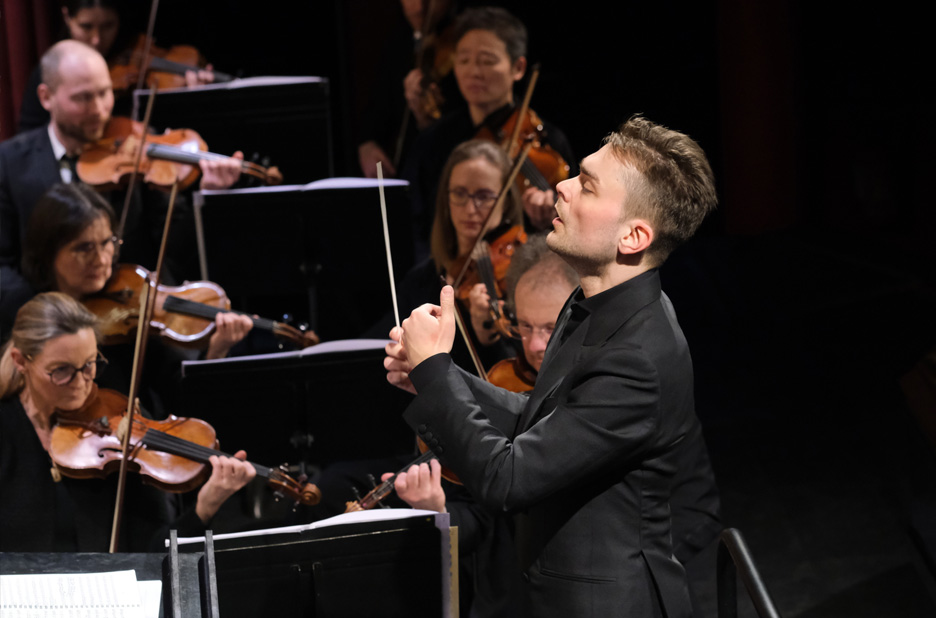
As the evening progressed the young conductor Jakob Lehmann increasingly impressed with his gentle but comprehensive control, notable grasp of the score and his movement which had nothing superfluous or showy but was elegant in its natural simplicity.
In the second part Méphistophélès appears, sung by Gerald Finley, trying to find Faust’s weaknesses the better to manipulate him. He first takes him to a tavern where the guests are thoroughly enjoying themselves. One of the drinkers, Brander, sings a comedic song about a rat who was poisoned in the kitchen, followed by a funny fast fugue on the word ‘Amen’ which the choir delivers with gusto. Put off by the vulgar amusement of the drinkers Faust asks Méphistophélès to show him some more suitable pleasures and Méphistophélès obliges by sending him to sleep with his soft-spoken aria Voici des roses while showing him a vision of Marguerite which immediately spellbinds him.
After the satisfying mixture of joy, exuberance, irony and meditation in the first two parts, the third and the fourth appear a little bit more predictable, staying within the traditional orchestral melodic space, however Berlioz’s melodic and dramatic momentum are never in question. We finally meet Marguerite, whose part Véronique Gens sings with restraint and elegance, notably in the lovely medieval-sounding aria Le roi de Thulé accompanied by a viola solo.
The masterful imaginative variety of Berlioz’s composition and orchestration held the interest throughout, enhanced by the competent work from the musicians to keep this complex creation on track. It was particularly exciting to hear the French libretto sung by such confident and dominant French choir showcasing the strengths of this fascinating work.