Book
The anniversary
Andrea Bajani
5/5
Family as a dutiful addiction
Step by step Bajani takes us through his absorbing scalpel-sharp analysis of family disfunction, revealing en route the minute mechanisms of its inescapable endlessly repeating patterns. The father is a textbook bully, after a while entirely predictable, but his cruelty never leaves you cold. To have a personality incapable of deviating even for a moment from all-encompassing narcissism must be a torture for the bearer but is still completely inexcusable. The mother on the other hand is an extreme example of female matrimonial martyrdom that the reader marvels at in horror. And then there are of course the children, sister and brother – the narrator, hostages for life.
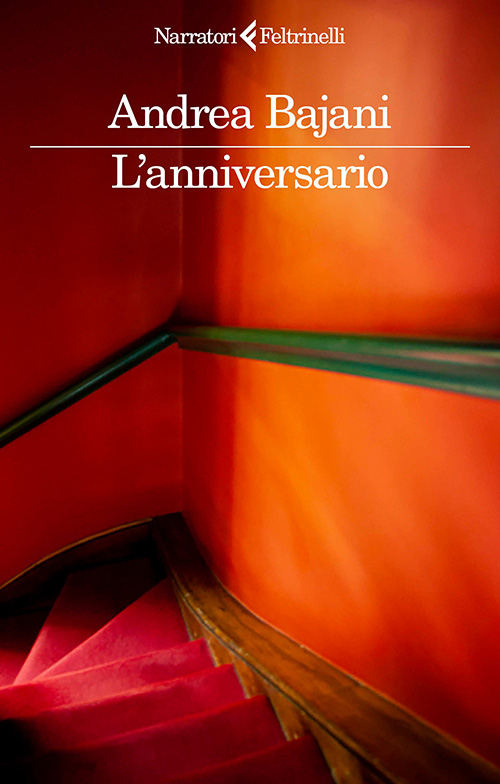
Awarded the prestigious Strega Prize in 2025, L’anniversario (The Anniversary) takes on the form of melancholic autofiction and is a gripping fast read. In simple, calm, stylistically elegant sentences Bajani circles the misery of the narrator’s life. On the face of it nothing seems terribly wrong, everything can be absorbed into the everyday, into an existence that seems ordinary. But little by little words, gestures, actions, reprisals, fears and manipulations accumulate to form walls of a prison, an ‘internment camp’ as the author calls it.
The story at first focuses on the mother, compliant to the point of total insignificance and invisibility, a mannequin whose truth perhaps only a novel could discern. Her husband has absolute power over her so much so that the narrator starts to believe she is completely indifferent to the matters of life and death. The narrator is puzzled by her abasement and is trying to elucidate it, to understand it. But her abnegation becomes denser, seems to go beyond the needs of patriarchy or abusive husbands. It is an enduring mystery why a woman would do this to herself, and to her children. How is it possible that she doesn’t at least dream of escape? There are tiny rebellions which fizzle out or are easily quashed but they don’t suggest that this human being really understands the magnitude of her servitude.
The narrator’s confessed cowardice mirrors that of his mother in an uncomfortable manner. Often the one to try to calm his father obsequiously when his behaviour threatens to escalate, the narrator abhors his role in the family, worse it makes him physically sick, but he is incapable of altering it. His sister is rightfully resentful of the role he has accepted which destroys the possibility of their siblinghood, the possibility of them jointly standing up to their father.
The narrator recognises that his mother’s invisibility is partly due to her being in his blind spot. He unknowingly absorbed his father’s dominant viewpoint, just as much as his mother did, and even while desperately trying to pre-empt his father’s worst excesses. The narrator tries to flesh out his mother’s character, and this proves difficult, as he has so little to go on. Nevertheless, he feels compelled to try to bring her out into the light. It is not a flattering portrait.
After the narrator leaves the family home to lead his own adult life in Turin, he returns rarely and reluctantly, and always with trepidation. Always gripping keys in his pocket, always ready to run. Until finally one of these visits becomes the last visit, and the narrator decides to cut ties with his parents. This only becomes possible as a result of the help of an unusual woman who gives unorthodox sessions of psychotherapy. She was silently recommended at the back of a bill by the pastry chef in his regular local breakfast joint in Turin. Someone who recognised he needed help.
Cutting ties with your parents is almost universally frowned upon. Many people strongly believe that this a temporary aberration which has to be swiftly remedied. And yet, when those who should provide support only repeatedly hurt you, this is the only effective solution to preserve your mental health. It brings liberation, but it can never erase the past.
In the novel the city of Turin represents an essential refuge, a place where the narrator manages to partly recover over time. The network of acquaintances and the noise of the city are credited with healing powers. So is his first wife who bears the brunt of the damage. The anniversary from the title is the ten years since the narrator last saw his parents. This ambiguous milestone is probably closer to a victory over addiction. The psychotherapist’s lesson, that a more honest manner of communicating violence is through precision, finds an organic and authentic expression in this excellent novel.
Translated by Geoffrey Brock