Art
Howard Hodgkin: In a Public Garden
Pitzhanger Manor & Gallery, London
5/5
Freedom of colour
One of the best British artists of the last half-century, and perhaps the most masterful colourist, Howard Hodgkin needs no introduction. Over the years there have been many exhibitions of his work, large and small, in public or private galleries, but every time, whether revisiting the same infinitely vibrant colour abstractions or discovering new ones, I could safely say that the excitement of being in front of a Hodgkin painting is rarely matched by other artists.
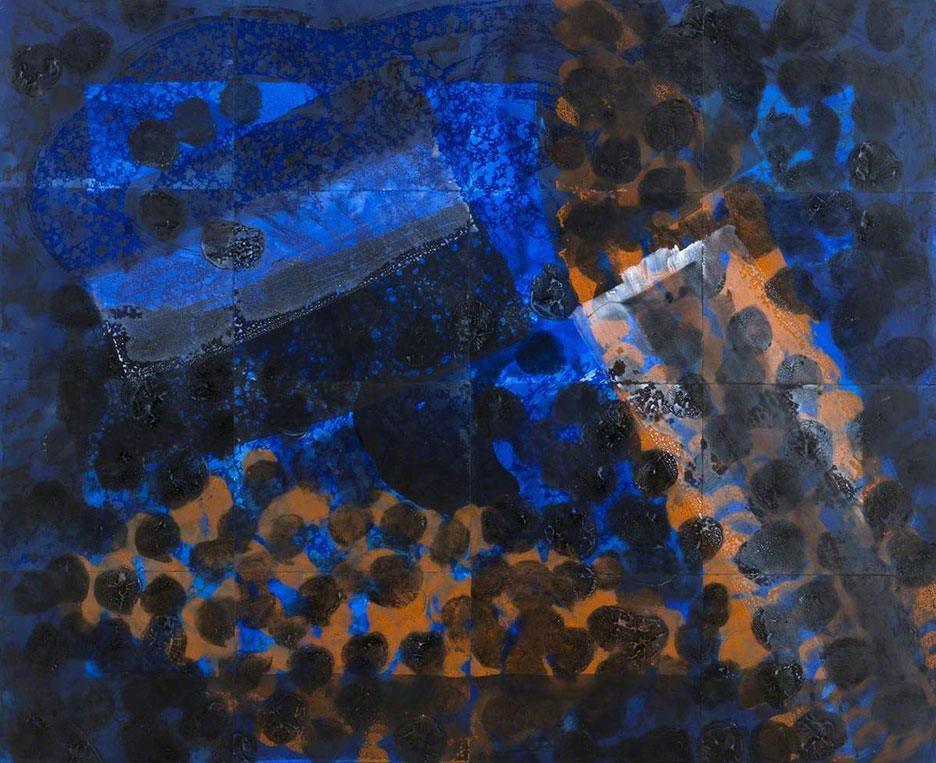
Consisting of five paintings and 46 prints, this exhibition is more substantial than one would expect with Hodgkin’s work acclimatising well to this elegant neoclassical mansion. Pitzhanger reopened after renovation in 2019 and now has a separate modern gallery space where the majority of the works were displayed, however a smaller number were dotted around the main manor building, in groups or on their own, and this worked well, combining the discovery of Hodgkin with the encounter with this beautiful and impressively restored building by John Soane. The brightness and clean classicism of the space could not but enhance Hodgkin’s expansive colour schemes.
A series of early lithographs (1966-1970) were displayed in one of the mansion rooms demonstrating the road travelled from geometric shapes in primary colours to Hodgkin’s mature fluid and rich colouristic style. Reassuring to know that you can’t become a supreme colourist overnight and that finding your own distinctive style can take some time. The subsequent series of screenprints called More Indian Views (1976-1981) attest to the painter’s style becoming more atmospheric and personal. The first print Sun (1976) is striking in its effective simplicity, bridging the gap between geometry and unmodulated colour of the early works and the conquering personal perception.
The way Hodgkin paints frames as extensions of pictures has aways been a charismatic gesture, bringing his ‘emotional situations’ closer to the viewer in a playful and exuberant manner. It has been said that the more the feeling captured is fleeting the more likely Hodgkin was to paint the frame. But this obviously takes some planning, as in order to seamlessly include the frame, the work can only start once the canvas is already framed. Hodgkin’s art is after all less improvisational than it may appear.
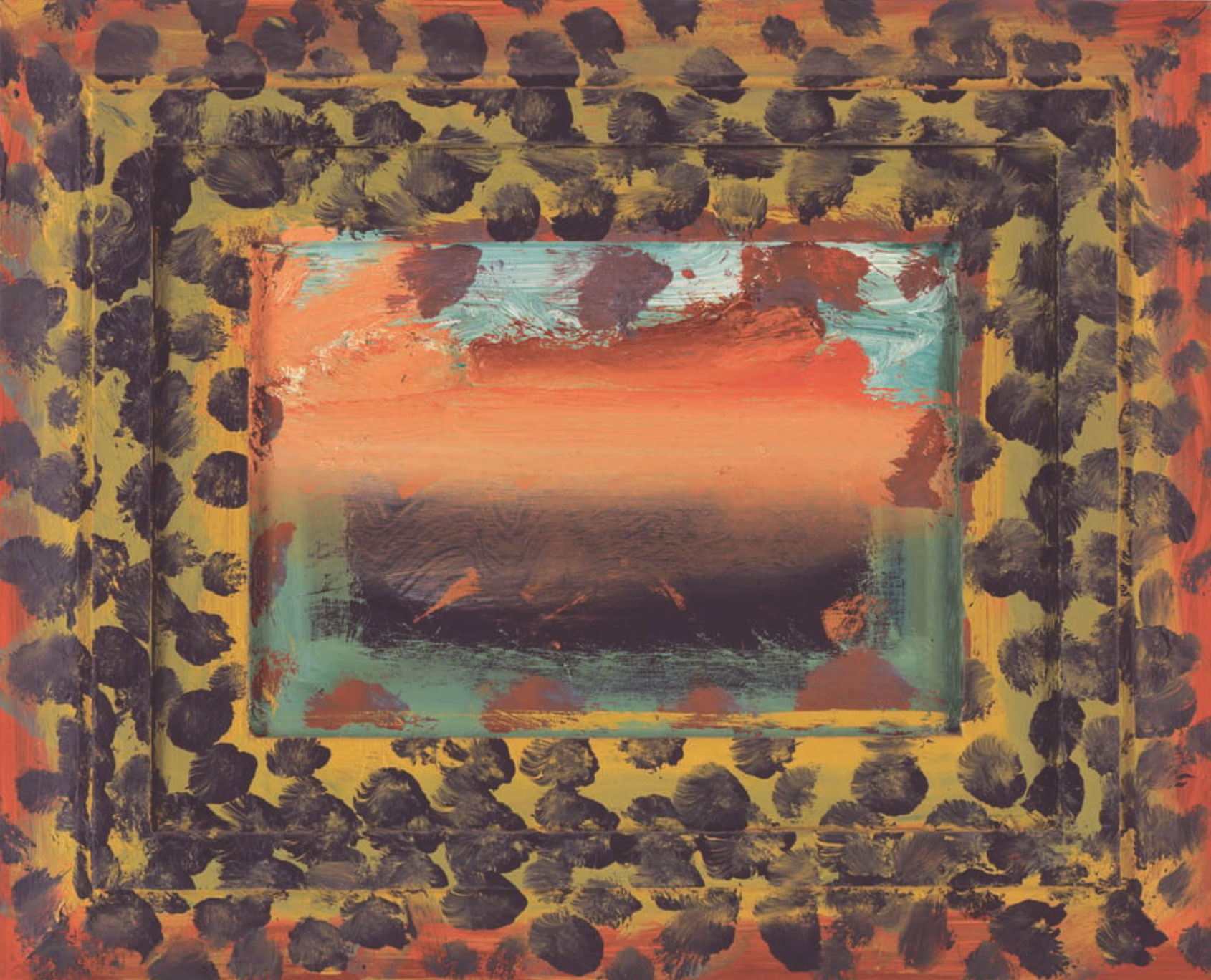
The best-known painting on display, View from Venice (1984), is an incredible combination of Venetian colours, the pinks, the blues and the yellows, like Santa Maria della Salute on a dark pedestal, above the turquoise water, reduced to its pink essence, its surroundings effaced. Although the turquoise barely has any space, it is remembered as the defining colour, with the frame acting as a window in full bright sun. This is a very small painting, but it fills your field of vision with sunny exuberance. The black dots on the yellow-orange frame bring to mind the postimpressionists currently at the National Gallery enhancing the perception of colour with optical techniques. I often thought that Hodgkin’s dark dots on a bright background, usually on the periphery and frame, but sometimes taking over the entire painting, express what happens to the human eye when trying too hard to look directly at the sun. And indeed Hodgkin seems the kind of painter who faces the light from a distinctive perspective, never offering the bleached or drab reality, but an internal and intense reworking of the pleasures and feelings of colour.
Most of Hodgkin’s prints are hand-coloured and sometimes incorporating several printing techniques which makes them more unique. For a colourist Hodgkin creates some stunning monochromes too, reminding us of his skills for composition and tone. Black Moonlight (1980) for instance works much better than its multi-colour version, also on display in the same room. This hand-coloured lithograph uses the earthy brown shades suggesting a calm and indefinite night ambience where semi-opaque objects and textures overlap.
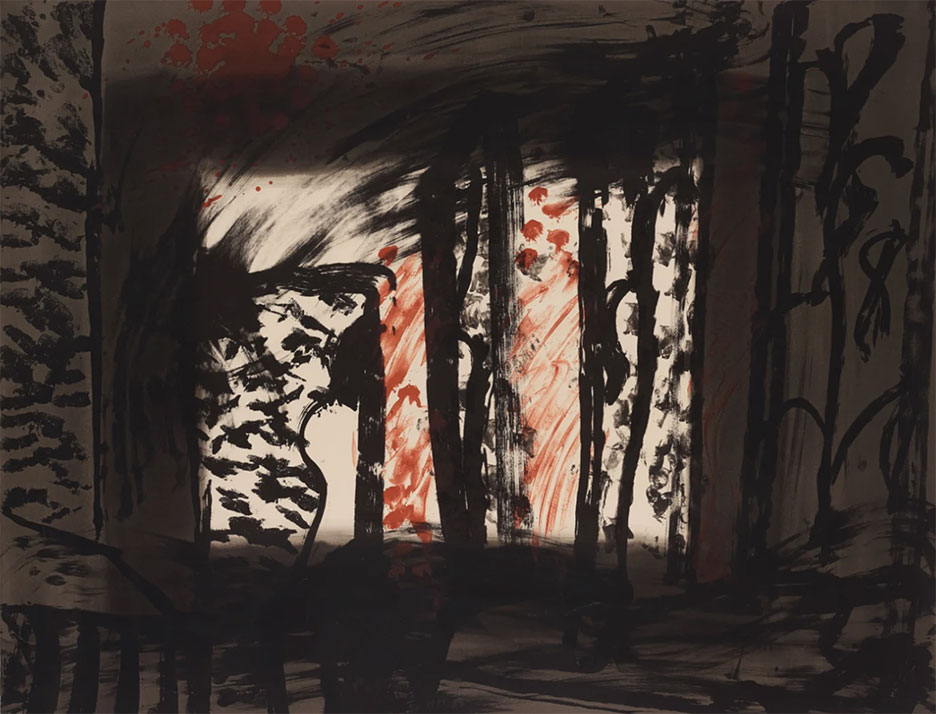
Another lithograph Sand (1982-1984) offers an exotic calligraphic impression, with a few russet marks warming up the mostly black and white view. Blurred and darkened edges suggest a frame of a window or the periphery of human vision – like a restricted view from a darkened room in a hot country, focused on abstract vertical textures, perhaps bars on the window or trees exposed to sun and wind.
One of Hodgkin’s last paintings, Portrait of the Artist Listening to Music (2011-2016), a linear rhapsody of abstract music notation, captures the joy of following music lines. I like to imagine that the black splodge with a golden rim in the middle represents a lounge chair, seen from the back, inside which one could discern a possible outline of a person listening.
The only weakness of this exhibition is the Hodgkin film, too blurred and bland to engage. But a film at an exhibition of painting is secondary, particularly when there is so much actual art to appreciate. For instance, the most luxuriating vibrant blue of the night sky is revealed by the lift-ground etching and aquatint Venice, Evening (1995). The colour communicates directly and immediately to be followed after a few moments by the ambiguities and nuances of the composition and texture.
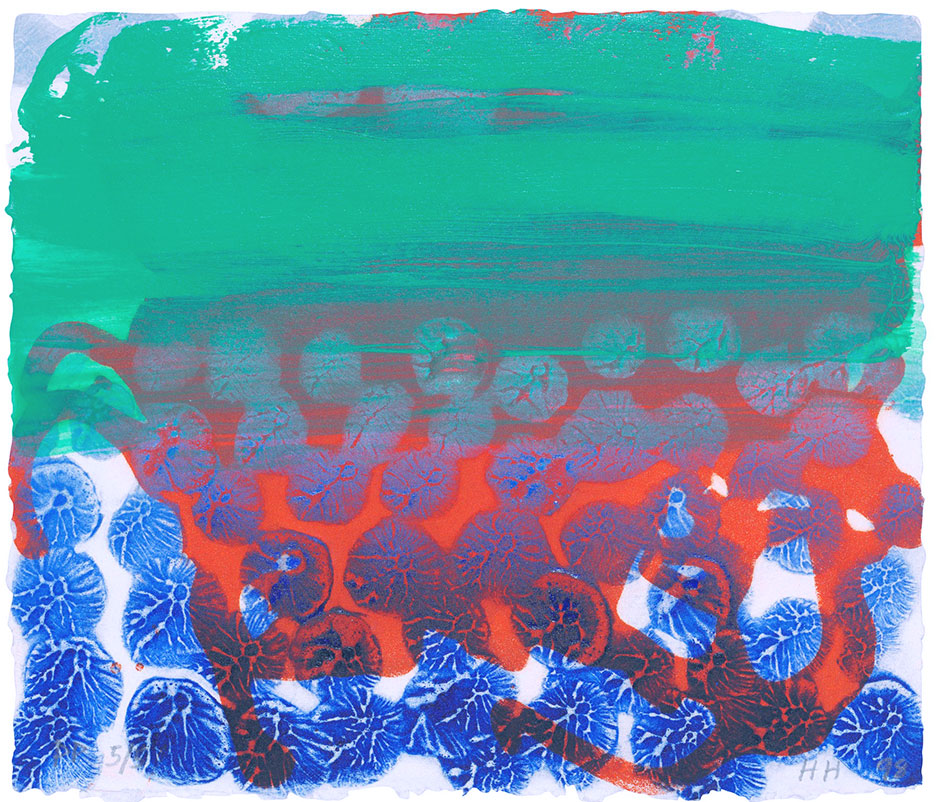
In a Public Garden (1997-98), another lift-ground etching and aquatint, suitably placed on a red wall, symbolises best the location of this exhibition, the manor overlooking Walpole Park. Nevertheless, the colour scheme is much more vibrant than anything seen in a tame English garden. But you could say that the bright greens, reds and blues, extrovertly mixed, stand perhaps for an ideal garden where the colours would be in your mind’s eye first and foremost.