Theatre
Mass
Donmar Warehouse, London
4/5
Is some reconciliation possible?
Initially conceived and written for the stage by Fran Kranz, Mass was first made into a feature film in 2021 and it is only now at the Donmar that it is receiving its world premiere as a play. It talks about grief, hate and acceptance in the wake of a school shooting somewhere in the USA. Two sets of parents have chosen to face each other on neutral territory, parents of the murderer and of the victim. At first we don’t know exactly what had happened, although we suspect some tragedy has brought everyone together. Later we find out that the shooting happened a while back, but unsurprisingly families are still grieving and struggling to control their anger and pain.
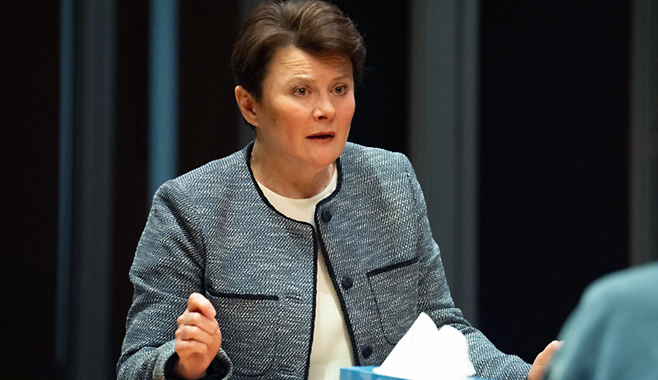
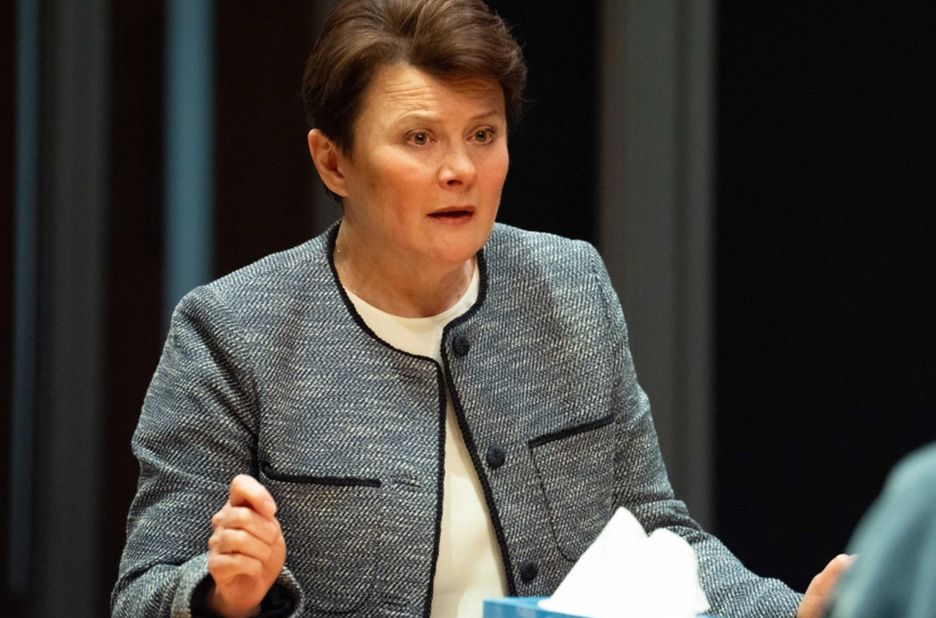
The piece starts simply with the facilitators and caretakers arranging the room which has been rented in an anonymous church hall. Very slowly tension increases as the meeting unfolds, with the parents seated around a rectangular table which rotates imperceptibly allowing the audience to study everyone’s face in turn and to see everyone from all sides. The conversation starts tentatively, everyone on their best behaviour, still keeping to what they promised themselves, to be open, not to attack, judge or demand answers, but then inevitably after a while, confrontations flare up.
The parents of the victim want to understand why the disturbed teenager who shot their son and his classmates was not helped earlier. Why have his parents failed to recognise what he is capable of and taken appropriate action? The murderer’s parents have examined their recollections and conscience at length and simply have had no cause to think things would escalate to such a degree. One always has to assume the best with one’s children, otherwise one wouldn’t be a very good parent.
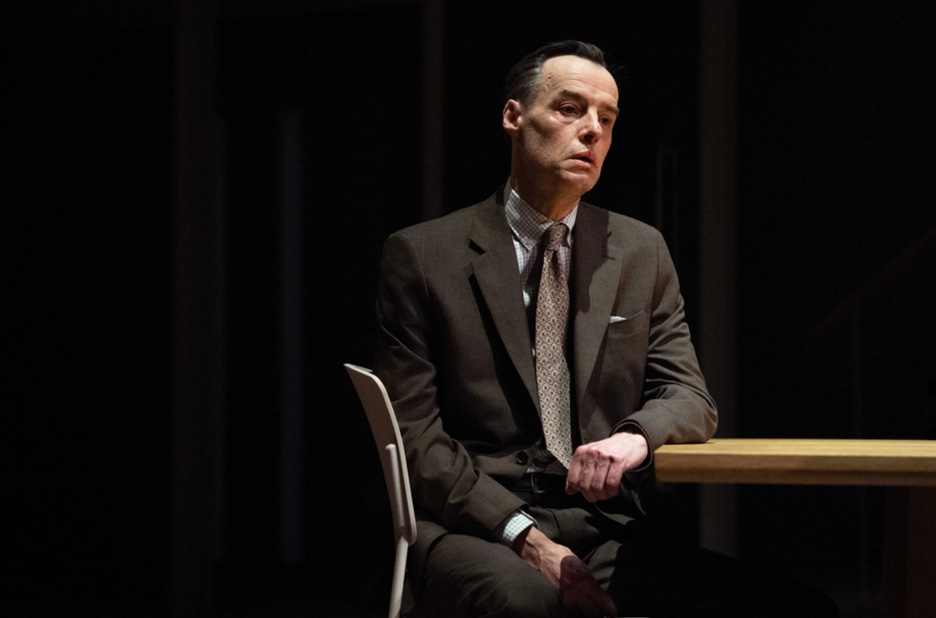
The parents of the murderer are keen to help in order to alleviate how they feel, but they also want and desperately need to keep some tiny nuggets of positivity and dignity for themselves. Their son didn’t target anyone specifically they believe, he was angry with the world. He didn’t want to kill, he just externalised how wretched he felt.
This is an actor’s play. The excellent ensemble moves us increasingly as the play progresses, Lyndsey Marshal and Adeel Akhtar on the side on the victim, Monica Dolan and Paul Hilton on the side of the perpetrator. We are all victims, the parents say several times, and this platitude, although true, serves as a safe word to calm everyone down. Monica Dolan’s performance as the mother of the shooter stands out in its brittleness and guilt, fighting to preserve her own protected space where she can still hold on to happy memories of her child’s early years. Later she breaks our heart when she finally allows herself to reveal her most private thoughts.
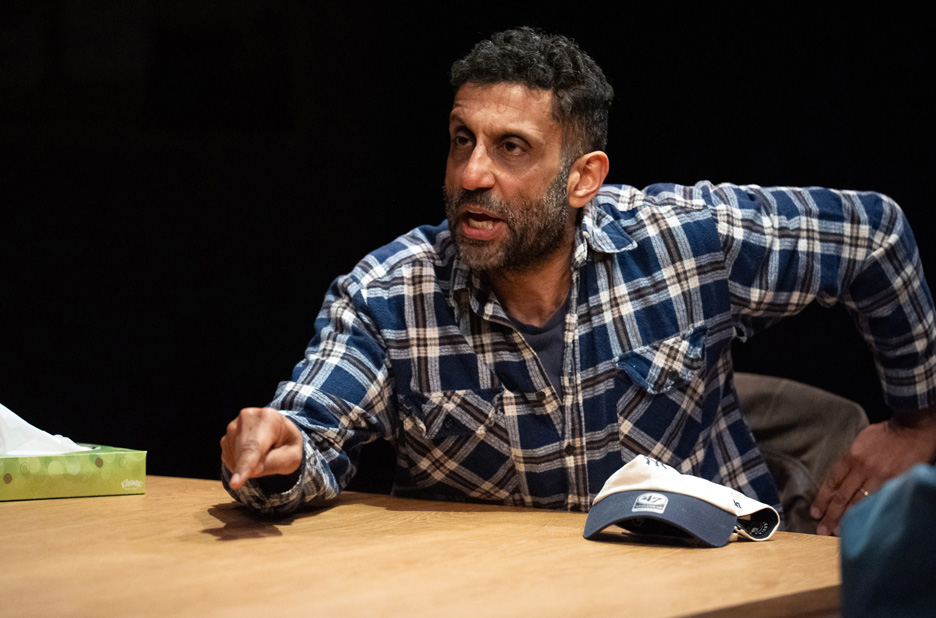
Fran Kranz avoids religious references except in the title, helped by the victim’s father’s clear distaste for religious answers, and this is for the best, as it would make it much harder for the audience to engage with the subject matter. Nevertheless, at the very end, when some form of reconciliation has been reached, the voices of the church choir practising in another room of the building permeate the air and their distant but calm spiritual message cannot but be soothing.
We never find out what links the two caretakers of the church – a middle-aged woman and an awkward teenager – with the visitor’s story. I wonder whether there is a connection which exceeds reasonable empathy, as if the two caretakers may have seen or experienced first, second, or third-hand some of the grief that animates the parents, or even that this experience may be in their possible future.
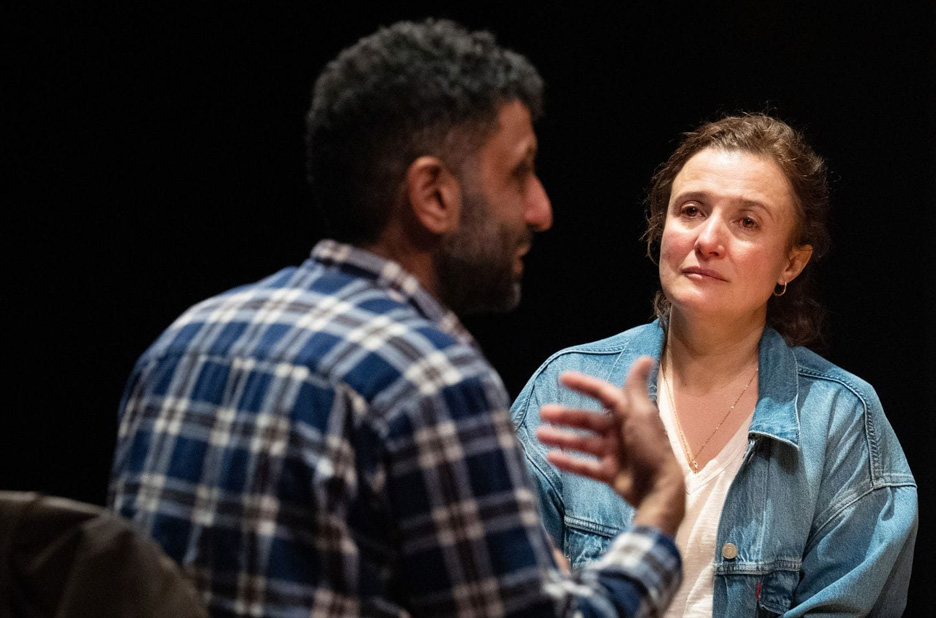
Mass is above all a low-key and natural real-time play. Carrie Cracknell’s direction is appropriately subdued, and the play very slowly intensifies to then at a slightly faster pace calm down again. The arc of slow-burn intensity is beautifully carved and connects the trivial everyday with the exceptionally tragic in a way that mirrors everyone’s experience. Some small measure of clumsiness, or excessive insistence on the banal in the dialogue, could be justified by the characters clumsily attempting to be respectful of others and sometimes clumsily failing.
The audience may wonder as to the purpose of being exposed to painful restorative justice which can never be conclusive or restorative enough. Nevertheless this play confirms that the old prescription we all know, but often find difficult to apply, that talking across the boundaries that divide us, hearing the other side fairly, can only help us accept, in a small part at least, that which we cannot change.