Book
100 whites
Kenya Hara
5/5
Meditation on white
Japanese designer Kenya Hara repurposes the list essay format for creating something with altogether more substance. Consisting of 100 short fragments meditating on the colour white and many distant ramifications of the concept of white in Japanese and other cultures, as well as personal practice and memory, these vignettes inspire with their lightness, playfulness and lucidity. It is indeed a fine collection of digressive thoughts from the perspective of observation and creation published in the beautiful white edition of Lars Müller Publishers with gorgeous smooth and sharp white paper.
Paper is inevitably one of the entries, the core physical fabric of this and any book, ever present in human culture and an essential shaper of human thinking over the centuries. The sensory mysteriousness of paper still persists despite it being such a ubiquitous object. Ephemeral and fragile, but also the archival material of our culture. Hara points out that were it not for paper human ability to accumulate knowledge and even to concentrate would not have evolved in its known shape. It is important to reflect from time to time on the objects of our culture. The Japanese have a habit of doing so which Occidentals could learn from.
As knowledge is increasingly stored in digital format, the use of paper is changing. Recyclable paper bag is multiplying, elegant, but impractical, mass produced, single-use item despite worthy intentions, the quality visibly deteriorating with increasingly cheaper production, to be used and discarded, despite the contemporary mantra that it is somehow a symbol of goodness. Is it more sustainable? Only in the sense that it can be recycled. But the high and low, mass produced and handmade, valuable and mundane meet in the use of the humble paper, the great cultural shapeshifter.
An entry called Corners meditates on the fact that a sheet of paper always has four edges and four tips, the boundaries containing and defining what is a page and what is on it. It is interesting to observe that sheets of paper are most often rectangular as if this is the most logical shape whose rationale we no longer question. And when we ear an important page, we stay within this geometry. A later entry called Squares expounds on the preponderance of squares and rectangles in human creation. Does our mind find the squares the most obvious choice for the crucial building blocks of our homes, cities, objects? The square itself does not often appear in nature, but humans use it everywhere.
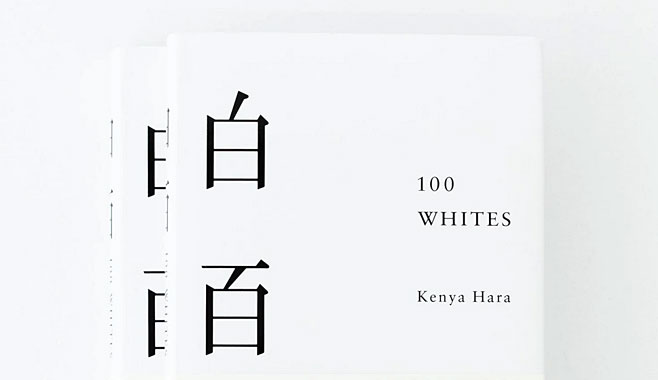
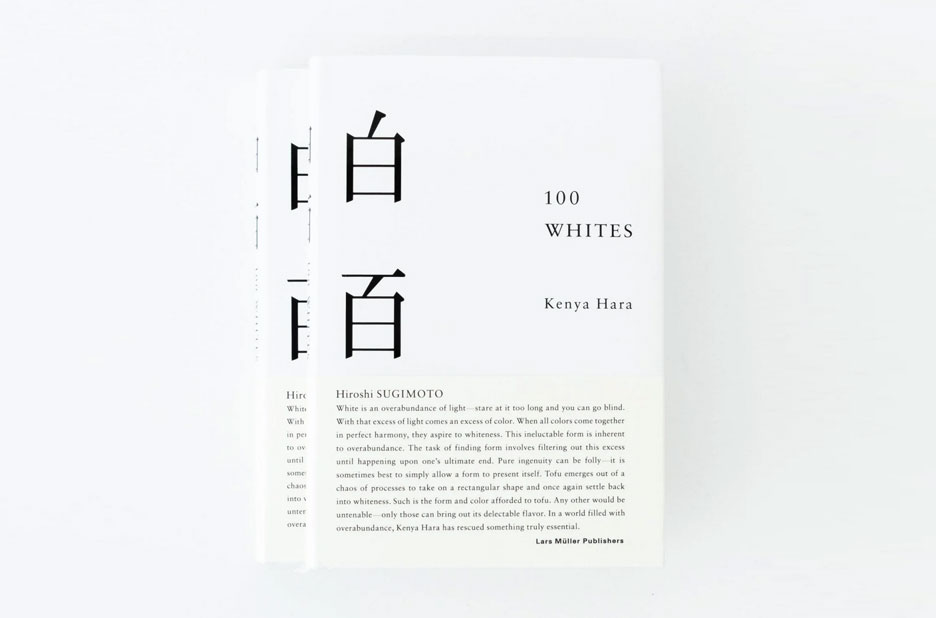
I have to dwell a little on the beautiful design of this book. It is sensually minimal and turning each page feels like opening a window in the morning to a full fresh snow covering. Each entry takes two sides, so that you can flick through the book like you would a flipbook animation of old, with the titles of chapters transforming one into another. Its compact chūhon size makes it easy to hold and keep a comfortable and pleasant contact with it while reading. It has a simple bright white fabric ribbon bookmark. The hard cover is matt white with crisp black print. The jacket is also white, but with a slight gloss, presenting its more extrovert side to the world. The different shades and textures of white of the pages, cover, bookmark, jacket and obi-band speak to each other inside their white world. It is a delight holding and leafing this exquisite Lars Müller edition designed of course by Kenya Hara himself together with Tomoko Nishi. And Hara proves what he preaches in creating a gratifying unity between form and content.

There are many inspiring entries, Snow for instance, the ultimate ephemeral white, still mysterious but quickly lost to the brown sludge after mixing with the materials on the ground. Walls as imperfect surfaces reflecting light with great sensitivity and the magical objects that are Boxes.
An array of food items are explored such as rice, milk, daikon, white peaches, eggs, udon. The sensual pleasure of eating favourite foods is complemented by instructions on how best to stage the tasting to full advantage. A peach for instance should be pealed and sliced, put on a suitable glass or ceramic plate and eaten with a silver desert fork, not to squander its scent and juice. It is advice well worth heeding.
No book about the colour white can be complete without the mention of ceramics. Rice bowls, the essential culinary utensil of Japan get a lovely entry. Hara observes that the culture of holding the bowl in the hand when eating is specific to Japan, hence the appreciation of the object that is a rice bowl and its tactile qualities inevitably forms part of enjoying food. This puts a different perspective on the importance of rice bowls as objects central to Japanese daily life.
White for Hara is not just a colour or colour perception and manifestation, it is also both emptiness and overabundance, a blank canvas with unlimited potential meanings, furthermore a state of dedication to a sense of purity in daily life.
100 whites is translated by Josh Trichilo