Art
Euan Uglow: An Arc from the Eye
MK Gallery, Milton Keynes
3/5
Melancholy of precision
I had never heard of Uglow before deciding to see this exhibition. Curious to see the reproductions in the flesh, I found the results mixed but nevertheless interesting. MK Gallery does it again in bringing to our attention a worthwhile review of another lesser-known 20th century artist. Geometry and invention co-exist in these paintings, often without decisive synthesis, which may not matter, as whether you like it or not, they show an entirely different perception of the world. Uglow’s obsessive precision doesn’t always communicate and can appear underwhelming and indifferent, there for its own sake, particularly in minor works. When the different aspects of his approach successfully come together, this is most often in still lifes, where the inanimate subject matter fits Uglow’s technique more advantageously and combined with the humility of scale creates pensive pieces which give themselves to meditative observation.
The painter was preoccupied with the nudes, perhaps because they resisted being turned into still lifes, but it is in fact his still lifes and portraits that reflect human presence much more distinctly. When the nudes’ faces are visible, they are often only vaguely and crudely suggested unlike the rest of their immaculately drawn bodies. The human mind therefore cannot consider them as objects, even though they are so devoid of human essence that they appear robotic. Without attempting to capture human facial expressions, the painter creates a strange contrast between real specific bodies and false generic faces, which occasionally teeters on the edge of the indecent.
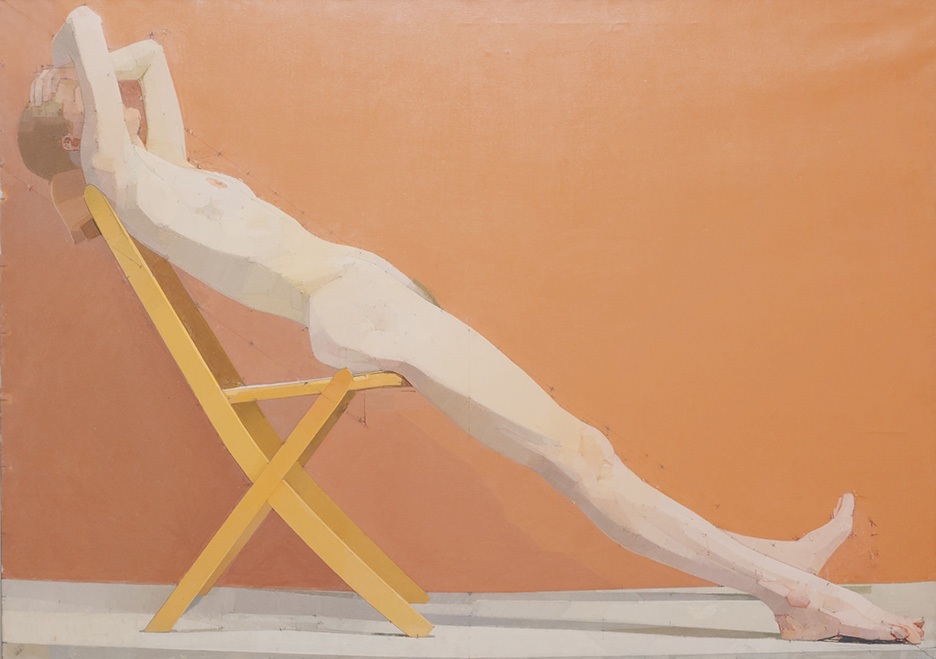
However, when the faces are hidden, due to the sitter’s pose for instance, the composition of the body functions like a still-life painting. The Diagonal (1971-77) is one such successful example, a tall model Jacque Rochester forcing Uglow to be creative with the geometry to contain her in. The travails of Rochester must be noted as surely holding this pose for long enough must have been pure torture. But the result is stunning. The anatomy and the chair dissect the plain warm red background intricately, with the chair almost as organic as the pale body. With the model facing the source of light to the right, the long shadows extend on the floor towards the left, putting in sharp focus the beautifully drawn feet, in what is contrived to appear as a natural flattering position. The shading of the body is equally immaculate, giving gentle volume to the curves of the diagonal. The lines of the body are then echoed in the straight and curved lines of the chair.
While Uglow paints from life, and with great accuracy and draughtsmanship in relation to perceived reality, the result is spiritually abstract and detached in an unusual way. In the video interview with Peter Hall from 1976 featured at the exhibition, Uglow talks of the painted body parts in a disturbingly disassociated way like a mass murderer admiring skin tone and wanting to prolong it forever. When his model for Root Five Nude decided that she couldn’t continue sitting for him, he proceeded to look for somebody else of exactly the same size and shape to be able to complete the picture. For him the model is just an inanimate object with certain characteristics, and once you acknowledge this you understand his still-life nudes better.
One wonders what kind of a teacher the seemingly on the spectrum Uglow was at the Slade where he worked for many years, but in fact he had a devoted following. He favoured very specific canvas sizes and painstakingly calculated proportions of elements in the composition. This is not something that is immediately obvious as you look at the paintings, however there is a certain classically harmonious balance to his compositions which is due to this approach.
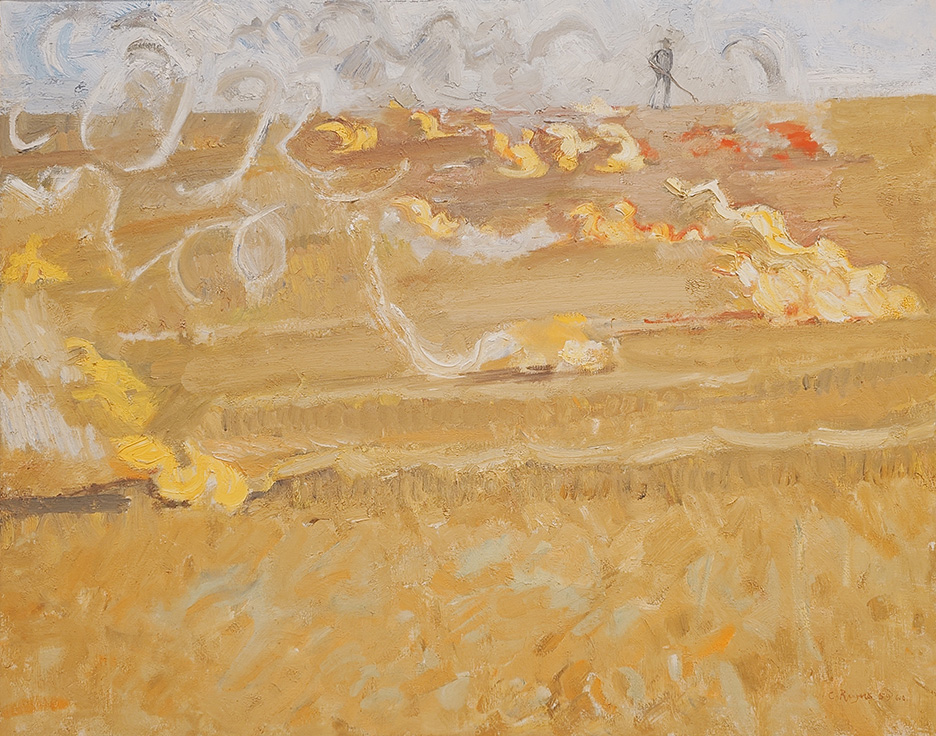
The Quattrocento and Morandi certainly come to mind when looking at Uglow’s paintings. Works of a few other painters who have influenced Uglow are shown in the first room: Cezanne’s The painter’s father (c. 1865), Giacometti’s drawing of his brother Diego (1950) and perhaps most interesting because virtually unknown, Claude Rogers’ Burning Field (1959-60), a good example of how shapes and forms can be used in a naturalistic setting to create a mesmerising composition.
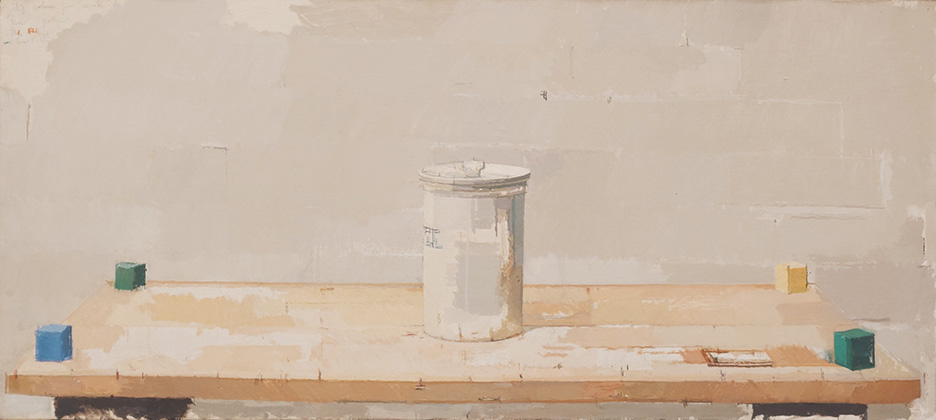
One of the most compelling concept still-lifes, Passionate Proportion (1964) organises the proportions of the space with squares and diagonals. Uglow commented that it should be like “electrical currents coming from those four cubes and making that pot in the middle”. Indeed there is a graceful imaginary arc that connects the tops of the cubes with the pot. The viewer’s attention is held by the tension of the balanced geometry and warmed by the pale colour scheme with just enough depth for the simple large pale pot to put some salutary distance between us and the wall.
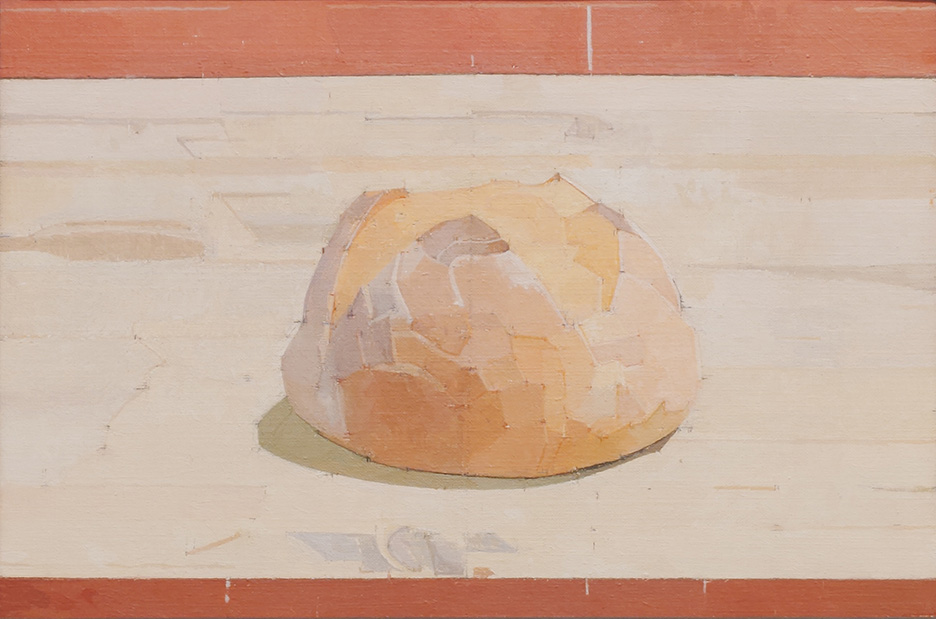
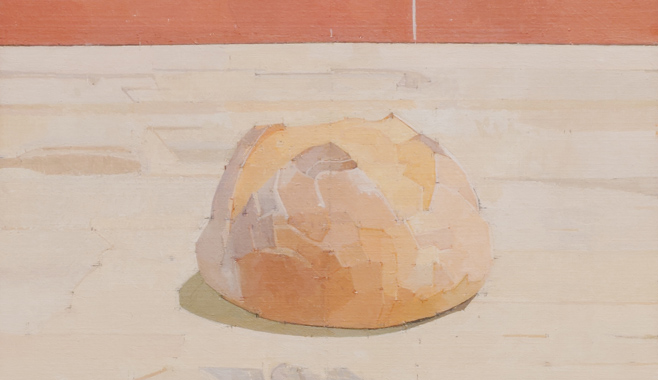
The exhibition concludes with a stunning late work, Mouse Loaf (1991-92), a small still life of a loaf of bread invigorated by two dark orange bands of colour at the top and the bottom. Uglow was known for taking months to complete his paintings, so it was hilarious to read that due to the painter’s slow progress the loaf was gradually eaten by rodents, so the painter had to fill it out with plaster. This is inadvertently the wittiest comment on painterly artifice.
The loaf is minimal, but real, Chardinesque with its delicious cracked surface, small delicate shadow and inviting yellow core. Its colour range is strikingly similar to the nude in The Diagonal. It surely is a modern memento mori, telling us to watch how we go.