Art
Hurvin Anderson
Tate Britain, London
3/5
Search for identity
Hurvin Anderson’s paintings work best when they creatively depart from the photographic material he uses as source and this is when his skilful verticality and geometry, luscious bright green tropical takeover and interesting ghosting and other abstracting textural constructions come to the fore to create a well-structured melancholic atmosphere. What works less well are freely assembled collages, with a deliberately rough appearance, often the ones trying to make an overt social or political statement on the black identity and experience.
This is my first encounter with Anderson’s work and I’m pleased that it is worthwhile, not just a Tate Britain’s tick in the box for social diversity. British painter born to Jamaican parents in 1965, Anderson is a Royal Academician and this exhibition, his first major solo retrospective, seems well overdue. His art dwells on the questions of cultural identity and heritage, the painter constructing himself through his visions of Britain and the Caribbean.
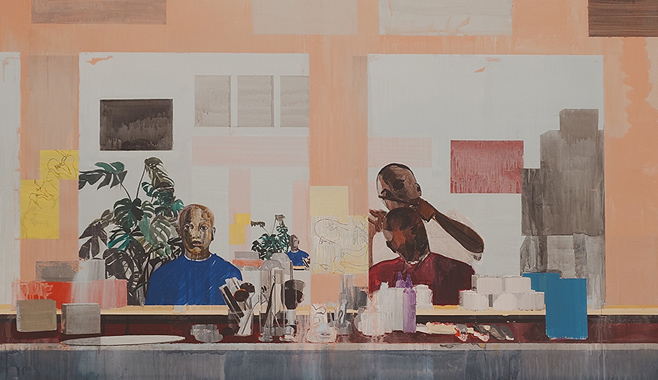
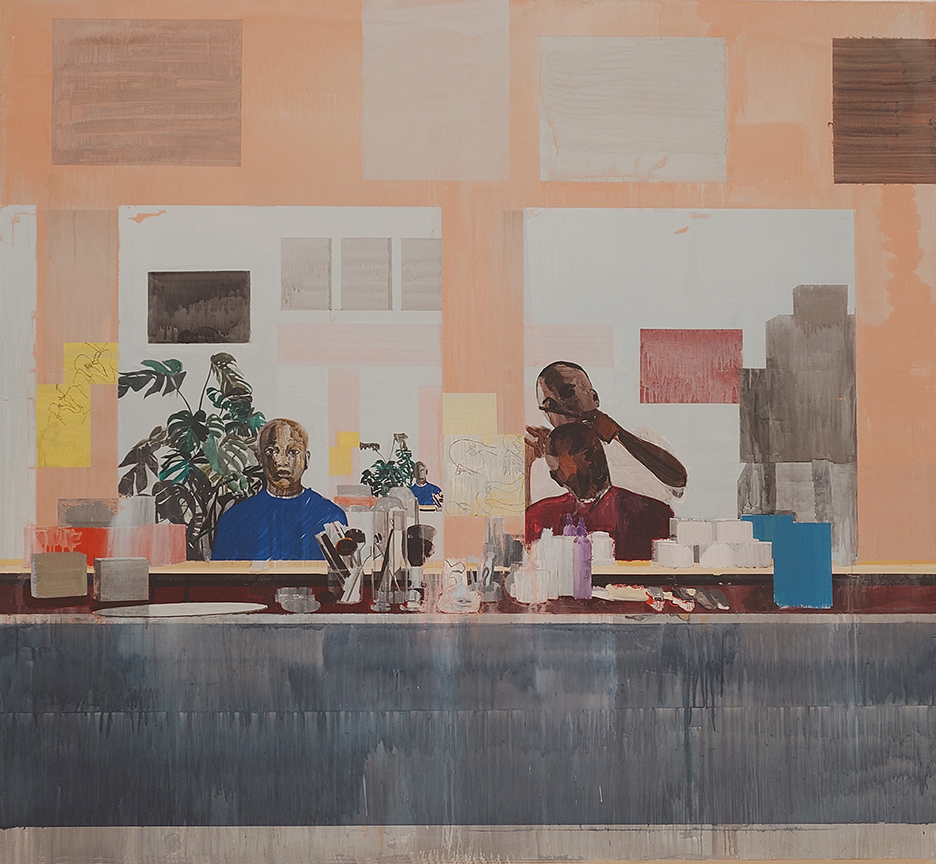
Art and the black experience are served successfully in Anderson’s more subtle pieces, such as the barbershop paintings. In Shear Cut (2023) two black men are getting their haircut, but only one of them is seen clearly on the left, looking at himself in the mirror with calm torpor. This man is the focus of the painting and all other multiple tentatively drawn reflections of various people in the mirror emphasize his focus on himself, serious, yet absent, the expression we all often adopt at the hairdressers, when we have to sit still and wait for the work to be done, our mind free to roam.
Boxing the two men in the mirror-size cutouts of the light peach-coloured wall creates an engaging composition and the warm pastel colour lifts and grounds the canvas as a whole. A small and colourful reflection of our main character is placed in the middle of the canvas, just off-centre, alluding to other hidden reflections of self in art history. Furthermore a plant intruding to throw a shadow on the man’s face contributes to the questions of identity. It is a powerful representation of our being in the world. Anderson’s identitarian quest finds its best expression in this structurally complex but emotionally clear pensive piece.
Black barber shops are perhaps the only spaces in Britain which are solely the territory of black men, their refuge from the white world and a community marker of their difference. Another earlier painting of the barbershop entitled Jersey (2008) is sparser and without human presence so much so that the observer wonders what kind of interior this is before noticing the clippings of black hair scattered on the floor. Guessing the content seems part of the game of enjoying Anderson’s work. The colour rectangles work well here too, denoting posters or pictures on the walls and their mirroring, adding colour and an air of structural mystery.
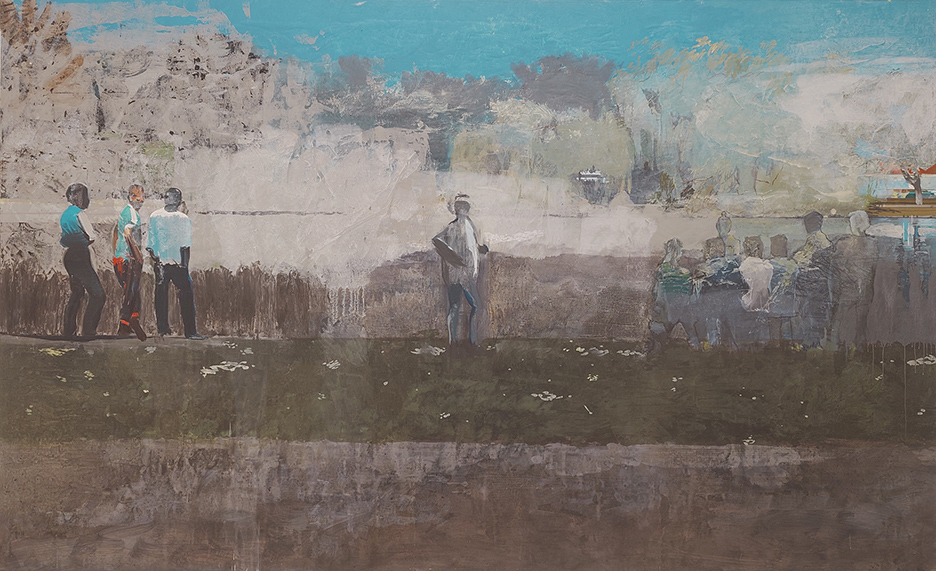
Ball Watching (Five-a-Side) from 2010 shows two groups of people on the two sides of the canvas observing an unseen game in front of them while a lone man in the middle, his features only vaguely suggested, has turned slightly towards us as if he has just noticed the photographer. The isolation of the sketchy man in the middle is clear and his somewhat self-conscious body posture coupled with the gently ghostly superimposed vegetation around him make this painting not about football at all.
The Welcome series does not fulfil the promise of its concept pictorially, the wrought-iron fences flat and unremarkable on top of buildings. However the Caribbean landscapes such as Untitled (Red Flags) from 2004 and Maracas II from 2003, depicting the verticality of forested hill sides and faint human figures – the vertical brush movement perhaps suggested by the direction of the shadowless midday sunlight – propose fertile slippages of perspective and meaning.
The tropical saturation of vibrant colours and the large scale of canvases play a crucial part in convincing the viewer of Anderson’s point of view, but one regrets that the organisation of the composition into squares remains visible sometimes in the gaps, confirming the artificiality of the works and thereby somewhat clipping their wings.
One depressing grey concrete sight of Britain finds its way into a recent work, The Banqueting Palace from 2026. This painting is the most devoid of colour in the exhibition and is a stark indictment of the unwelcoming infrastructure from Anderson’s memories. Sadly even the representation of this reality cannot be made any less depressing.
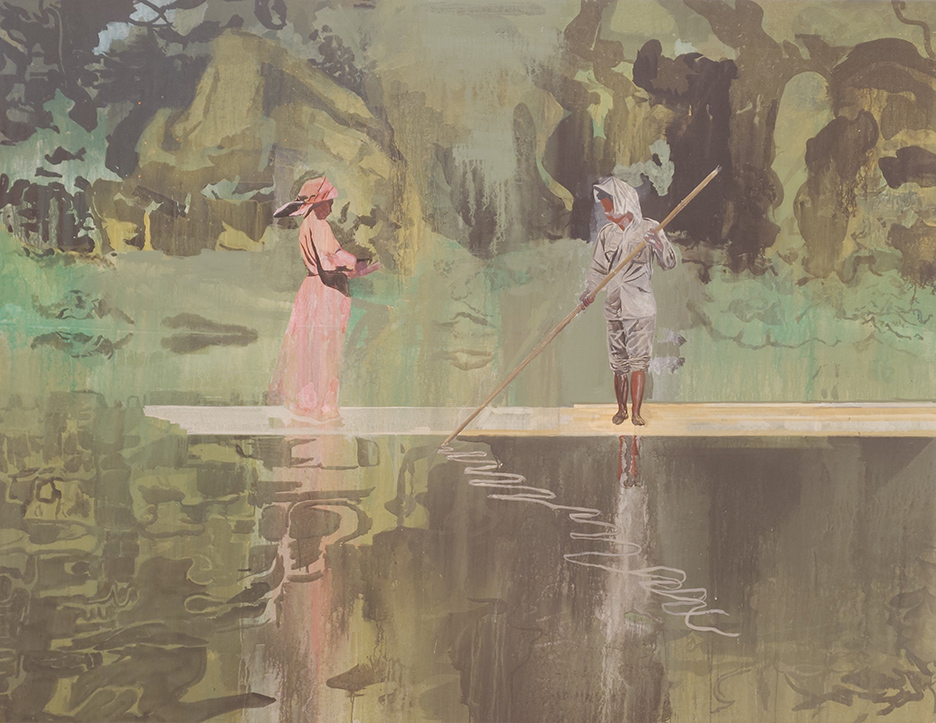
In the last room there are four paintings created for this exhibition conversing across the square space. The most striking, Rafting (2026), sets up an encounter in the lush landscape reflected in the water. The headwear of the two protagonists facing each other, a man and a woman, provides a lovely symmetry and hides most of their faces. The punting pole writes their story in the water.