Theatre
Man to man
Royal Court Theatre, London
4/5
Swinton mesmerises as defiant survivor
It is exciting to see Tilda Swinton on stage. She rewards our anticipation by flexing her acting chops much more than we have seen in her recent celebrity appearances in films. You just can’t take your eyes off her. She wealds this role like an axe, but in the cracks of the devastation you can glimpse the fear, the distress and the unrest.
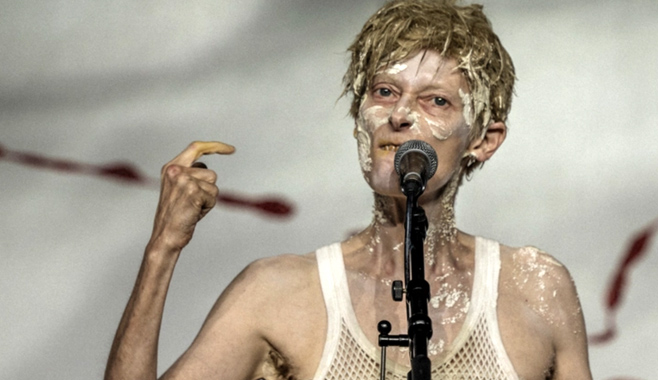
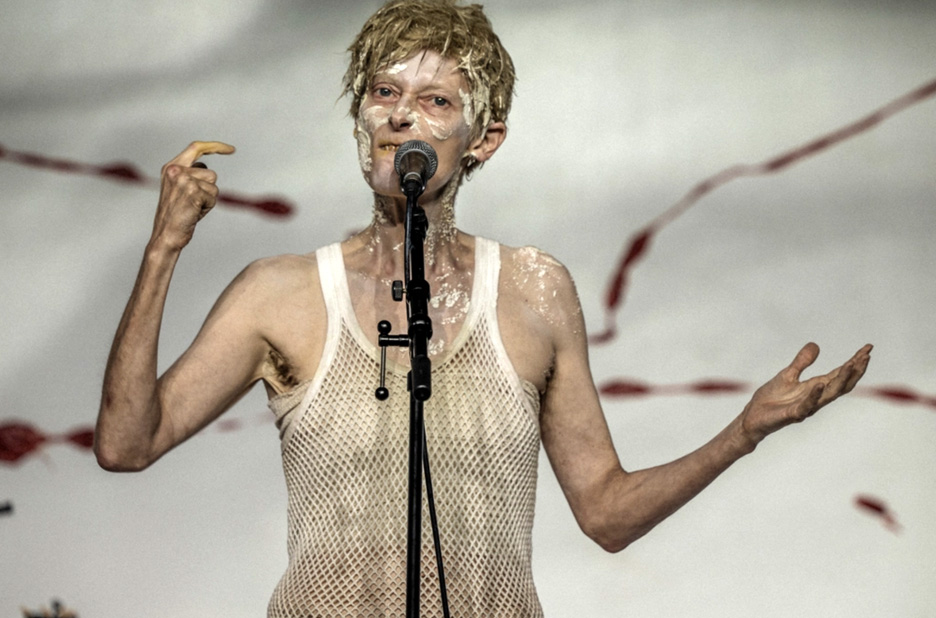
The East German theatre director Manfred Karge created the one-woman play Man to Man in 1982 under the title Jacke Wie Hose. The English version directed by Stephen Unwin was first performed in 1987 at the Traverse Theatre in Edinburgh, transferring to the Royal Court thereafter to great acclaim. The Royal Court brings the original production back for its 70th year celebrations. The original adaptation by Anthony Vivis is used, Stephen Unwin directs again, the original stage and lighting design by Bunny Christie and Ben Omerod are also reprised. We have time travelled to 1987. And it is very interesting indeed. Punk may be dead, but it still has a lot to say about our world today.
This play has a distinctly Germanic anarchic feel, pressing on us existentially in the reliable Brecht lineage. It freely mixes the crass and the banal with quotations from German classics, history and popular culture. Swinton plays a working-class woman Ella, who in order to survive after the death of her husband Max, takes on his identity to continue his job as crane operator. Max’s identity becomes difficult to shake off for many reasons and Swinton revels in the androgynous ambiguity which so suits her. She enacts the gender fluidity lightly and naturally.
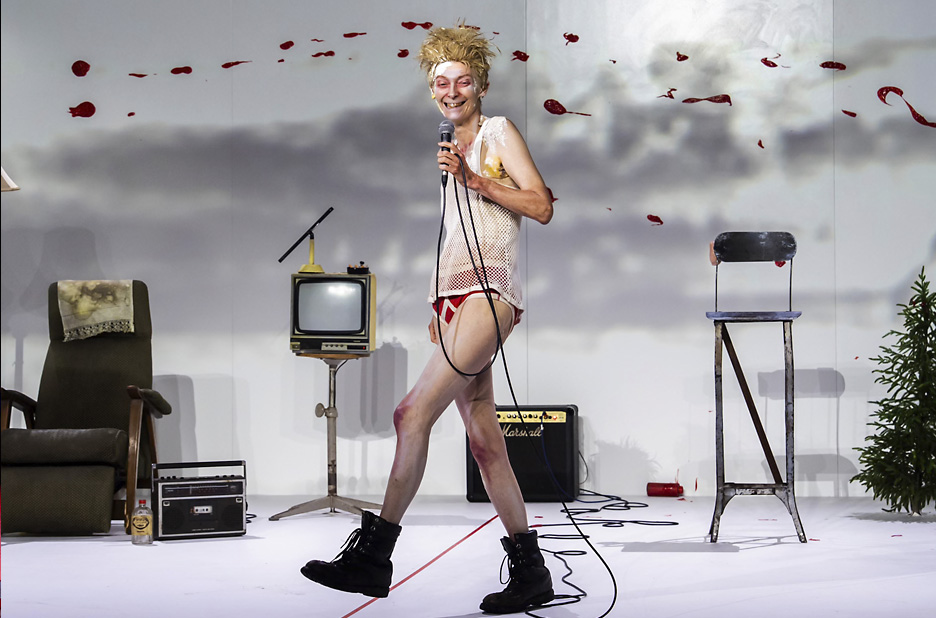
Ella does not much care if she is thought to be a man or a woman. She looks like David Bowie, or like Vivienne Westwood, or like any member of the Sex Pistols, her plain androgynous features transforming and reflecting. There is no vanity to Ella, her appearance retains all the marks of time and her difficult life. More than that she defiantly exhibits her damaged body. That at the age of 65 Swinton is still as ready as always to expose her human vulnerability to such as extent is remarkable and worth considering.
As Max, Ella survives some of the worst decades of German history, the poverty, Nazism, war. The narrative and language are coarse and provocative at times, Swinton adopting a cockney accent and strutting around in red Y-fronts, also from the original production, stuffing a cloth in them repeatedly to appear manly. But the provocation stays within the boundaries of the story, never self-indulgent. I couldn’t help remembering Gordon Brown’s off-putting ‘bigoted woman’, a diametrically opposed figure perhaps but equally buffeted by the times, helpless, damaged and indoctrinated, but determined to be heard.
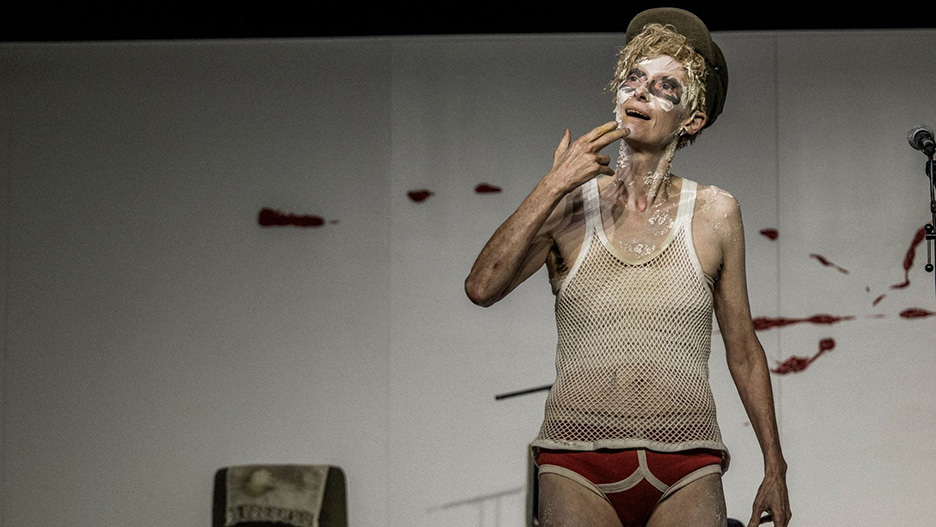
When mid-play Switon finally gives up the possibility of being able to assume her old female identity, at least officially, in order to help another woman in need, this is a very moving moment. We are all a collection of selves, but every shedding of a facet, even if we gain others in the meantime, is a blow to our complexity as human beings – and often an unrecoverable loss.
The playwright added two new scenes: one about the fall of the Berlin Wall in 1989 and another about the rise of neo-Nazism in Germany today. These fit well, emphasizing relevance, the latter giving the audience a bit of a chill, particularly in view of the recent election results from Germany.
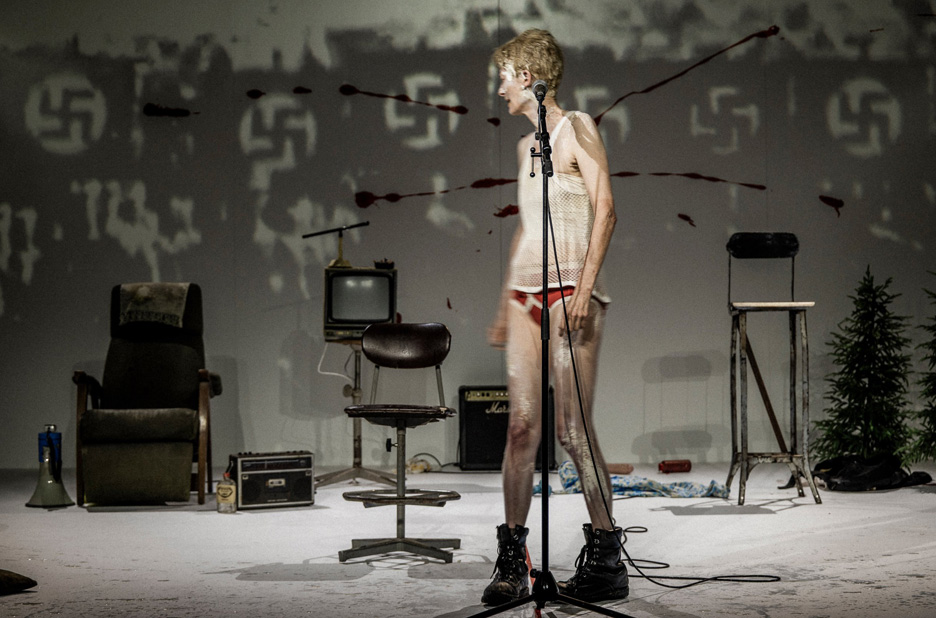
To quote Stephen Urwin: “Manfred Karge is one of the last surviving links to the original Brecht theatre. And in true Brechtian spirit, he has written a deliberately conflicted figure: likeable one moment, repellent the next; insightful and blinkered; reactionary and visionary; but throughout, a woman from the lowest rung of society, caught up in the disastrous contradictions of her time.”
Some have suggested that the play questions masculinity, but I would say instead that it tells us that femininity encapsulates it, that it is wider and more flexible. But also it heaps a lot of irrelevance on gender determination, although men are still seen as coarse predators. Refreshingly it doesn’t concern itself at all with trendy gender-identity over-correction. More importantly, like most of the 70th birthday season at the Royal Court, the play talks about what it takes to survive.
It is rare to see contemporary European plays staged in London. Man to man confirms that well-made challenging and grown-up theatre that is not purely seeking to shock can still be squeezed in between London’s popular commercial shows. All credit to the Royal Court for bravely bringing back this powerful German play which has marks of another era, but is often unexpectedly universal.