Theatre
Archduke
Royal Court Theatre, London
4/5
The making of a political assassin
I wasn’t sure whether I would like Rajiv Joseph’s new play as his Bengal Tiger at the Baghdad Zoo, staged earlier this year at the Young Vic, was interesting but lacking a convincing raison d’être. On first impressions the new play appears very different, because the humour – bleak and absurd mixed with some historical parody – is much more compelling and cohesive. However, Joseph’s approach and themes are in fact very similar across to the two plays and it is the directorial approach that marks a crucial difference. Lyndsey Turner, perhaps also influenced by the Darko Tresnjak’s direction of the New York premiere of this work in 2025, structures the text into an unusual and engaging statement on marginal societal forces which can decide on the direction of mainstream history. So far so relevant.
The play talks about events which led to the assassination of the Austro-Hungarian Archduke Franz Ferdinand in 1914 which is today seen as the starting point of the First World War. Gavrilo Princip, who killed Franz Ferdinand, was a poor Bosnian student who became a fanatical nationalist, fighting for the unification of Yugoslavia and the end to the Austro-Hungarian rule. The playwright makes him into a perfect martyr, a weedy spunky runt, yearning for meaning, eager to prove he is a man and a fighter despite his small stature. The fact that he was a student is erased and we see him as an uneducated unemployed man, abject poverty his most important attribute, although he attempts to reason and understand the world within the limits of his capabilities.
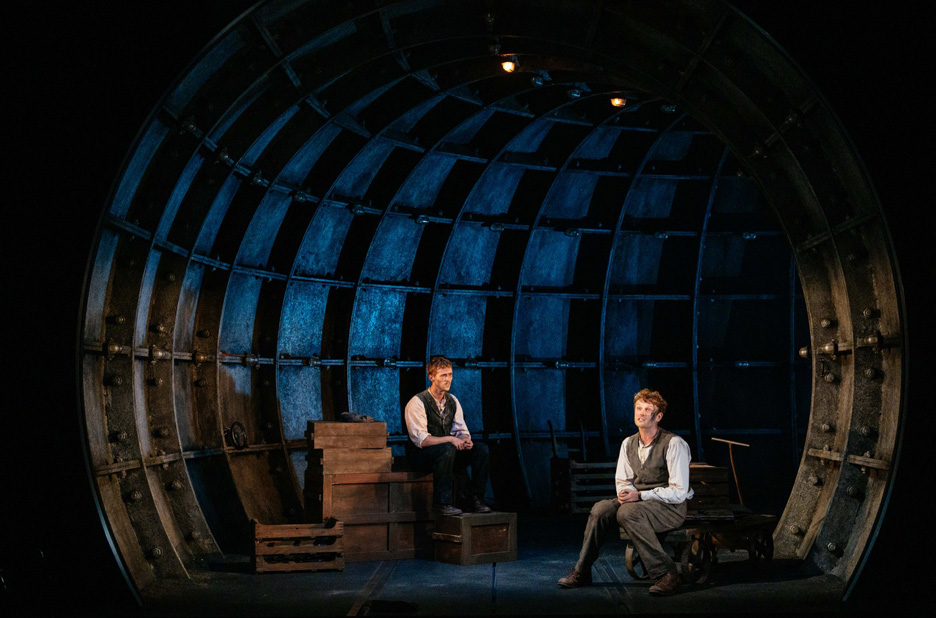
The play starts with a distinct feel of Waiting for Godot as two teenage boys suffering from tuberculosis, feisty, poor and scared, are waiting for someone to appear in a military tunnel. They spar and confer, revealing the amusing extent of their innocence and ignorance of the world. They are hoping for a job or some food at least. They are Gavrilo (Stanley Morgan) and Nedeljko (Chris Walley). The fight director Sam Lyon-Behan orchestrates their fights neatly, ensuring they are both comical and enjoyable.
Eventually they are collected and taken to meet Dragutin ‘Apis’ Dimitrijević whom they all refer to as captain. Wonderfully embodied by Marc Wootton, the captain is camp and eloquent. He is the mastermind of the conspiracy and the rotten core of the group, his intention to manipulate the naïve young men and use them to fulfil his resentful murderous plans. When one of the young men questions whether the captain is asking them to commit suicide, he smoothly responds that that it is simply a question of embracing Serbian national pride. The young men are easy to convince with some home cooked food provided by old Sladjana, captain’s co-conspirator.
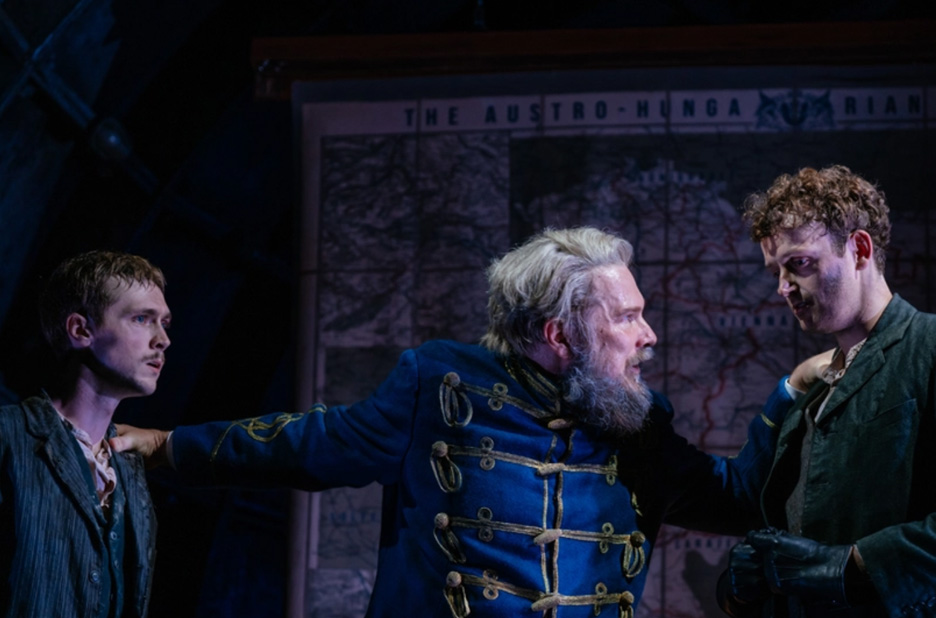
The captain and Sladjana are a fascinating combination, like a huntsman from Snow White and the witch from Hansel and Gretel. They are not a couple and don’t always agree, but their misguided fantasies mirror and fuel each other in the same way that those who believe in unhinged conspiracy theories are drawn together and support each other. Their bucolic dress is an inspired detail which makes them look as if they have just stepped out of a fairy tale. The element of fantasy which these two adults represent gels successfully with the young man’s ignorance and predicament, bringing to mind the whole gamut of noxious and fake simplifications on offer today. But the fairy tale also retains all of its cruelty.
The captain did indeed commit the regicide as he so proudly boasts in 1903 when he killed King Alexander and his wife, Queen Draga. He reminisces on stage how he ‘disembowelled’ them both, insisting on the word, savouring it in his mouth. In the second act he expands more on his obsession with Queen Draga, claiming that she asked for it, that she bewitched him to kill her, thereby descending even further among the ranks of ordinary murderers who always find the lamest excuses. This removes any tiny possibility of an honourable attempt to improve the world, even if it may have involved an assassination of a ruler.
The second act goes over the same ground again, developing the characters a little bit further, but ultimately failing to better the first. We are still on the other side of the historical event. Joseph’s attempt to excavate an alternative point of view on history works up to a point, conveying his fatalistic bias and some measure of explanation through absurd humour. The world depicted still resonates with the current balance of political powers, perhaps even more so due to the archaic overtones. And if you think this is an obscure way of saying that we are in the dark ages again, that is exactly what it is.
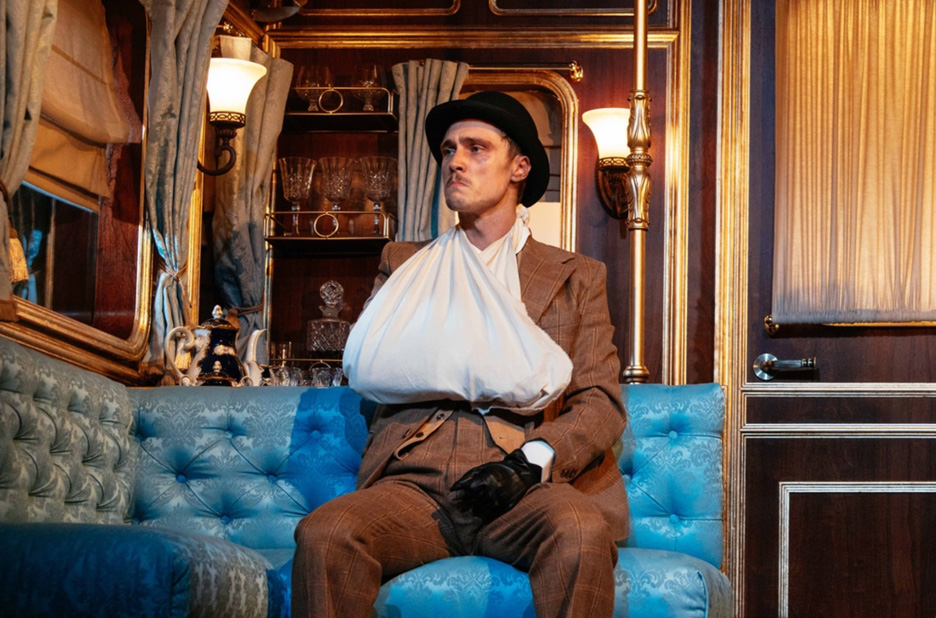
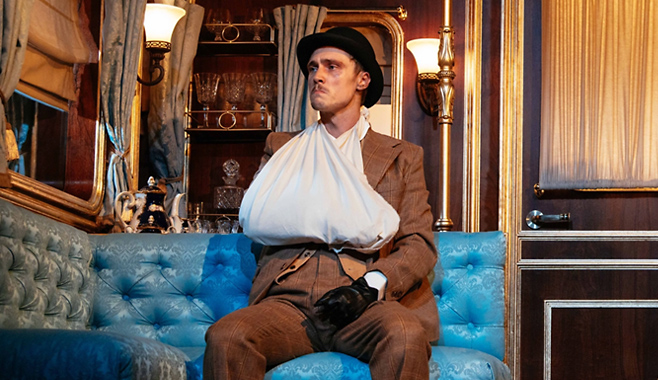
A luxury train carriage from the beginning of 20th century impressively rolls out onto the stage courtesy of Es Devlin and the three young men, on their way to kill the Archduke in Sarajevo, start to waver in their commitment. Perhaps it would be better to be forgotten, they concede. But the wheels of history have been set into motion. Alas, one thing we can safely say is that this kind of perverted and poisonous nationalist fanaticism is still allowed to shape our present.